“I’m busy” is a euphemism July 22, 2014
Posted by mareserinitatis in education, family, grad school, personal, work.Tags: children, dissertation, family, part-time, schedule, work, work-life balance
add a comment
I’ve read a couple articles about how we all get caught up in being so busy. A lot of them talk about how we need to escape the busyness spiral. Xykademiqz expressed frustration with people who are always busy.
I guess I’m coming at it from a different angle.
I’ve come to realize that the phrase “I’m busy” is just a polite way of saying, “My priorities are different from yours.” That is, the requested action is more important to the person asking than the person who is supposed to perform the action. Particularly relevant to my personal situation, it’s also a way to avoid saying, “I need time to work on my thesis.”
Because I’m starting to find that pretty much nobody cares if you need time to work on that.
“Aren’t you done with that yet?”
“You sure have a lot of time off.”
“I’m sure you can do that some other time.”
“Can’t you put it off for just one day?”
Except I’ve been asked to put it off more days than I even have available to push it off from. As much as I hate telling people I’m busy, I hate even more that people won’t respect my schedule. Part of the issue is that I am technically only part time at my job. If you’ve ever had to work part time at a job without a very explicit schedule, you can forget that. People want things done on their schedule, and when you’re gone you’re taking “time off.” Apparently raising two kids and a PhD is “time off.” I’m jealous of those people who actually get to take vacations on their time off.
A lot of times the outright rejection of working on a dissertation isn’t verbalized. Kids, in particular, really don’t get that you have other things to do besides take care of their needs night and day. Not that I can blame them as I sure wouldn’t mind if my mom showed up to clean my house once in a while. (I know, Mom…you’re busy, too.)
Admittedly, doing all of this is a choice. It’s just unfortunate that a lot of people don’t respect that choice. It’s particularly frustrating when people want you to do things that they’re capable of doing but are “too busy” to do themselves. It seems that rather than get into a verbal sparring match with them about how they disagree with my priorities, it’s just easier to say, “I’m busy.”
Time to get out of the lab November 3, 2011
Posted by mareserinitatis in electromagnetics, engineering, humor.Tags: characteristic impedance, children, misread words, names
add a comment
I received a card in the mail from a friend. When I opened it, and without reading it, my eyes feel on the letters Zo.
My first thought was, “Characteristic impedance? I didn’t know she was interested in electrical engineering, let alone transmission line theory.”
Upon closer reading, I discovered she was actually making a reference to her daughter Zoe.
I think I need to spend less time around electrical engineers.
Why I really work with my husband October 31, 2011
Posted by mareserinitatis in family, grad school, papers, research, work, younger son.Tags: children, family, Mike, papers, research, work
2 comments
This past week, I’ve been trying to get a paper ready to submit to a conference. My husband is a co-author on the paper, so we spent a good chunk of the day cranking away at it. I worked on the text while he fixed all the LaTeX issues we encountered. This is my first time submitting a conference paper using this method, and I wasn’t acquainted with all the nuances of the IEEE style. I guess I’ve lucked out because I either used Word (up until I finished my thesis) or let my co-authors deal with the issues that arose from LaTeX. Either way, the paper was submitted at 5:30 p.m., a whole 5 1/2 hours before the deadline.
Then we came home. He took the dog for a walk, and I went for a run. He cooked dinner, I showered. He took younger son trick-or-treating, I handed out candy while trying scarf down my dinner. (Older son held back Gigadog so that she wouldn’t a) try to steal candy out of the dish and b) slobber all over the trick-or-treaters to show them how much she loves them.) And now I can finally get to writing tomorrow’s lecture and grading while he gets the younger boy to bed. Oh yeah…and Mike has work to do, too.
It’s a good thing I work with my spouse or I’d never get to see him.
Kinetic theory of kids July 23, 2010
Posted by mareserinitatis in humor, science.Tags: children, humor, physics, science
add a comment
It’s always fun to bring my kids to play when visiting with my scientist and engineer friends. Inevitably, the most haggard of us will comment on “how much energy they have!”
My response for the past few years has been, “Oh, we have the same amount of energy as we do, they just have less mass.” This has elicited laughter, groans, and, more often than I care to admit, blank stares.
Therefore, I have decided it is time to proffer a full explanation as more than once I have wanted to say, “Go look it up on my blog.”
Energy, as you may know, has an amorphous quality about it: it makes things move, makes them hot, makes them roll downhill, but it’s hard to define. It’s just one of those things things that we assign a number to and use it to do calculations.
The most important things about energy are that 1 – it is conserved because 2 – it can change from one form to another. As an example, a ball rolling across the floor will slow down because it’s transferring the motion from its energy into heat. The energy doesn’t go away (is conserved) but simply changes to a different form.
Fortunately, for this explanation, we’ll only deal with one form of energy: kinetic, or energy due to an object’s motion. It turns out that kinetic energy is proportional to the object’s mass and the square of its velocity. Specifically,

As I said, energy is conserved. This means it can’t go away but just can be transformed into another type of energy. However, I half jokingly assert that kids have the same amount of energy as adults, so I’m corrupting the meaning. But, moving along, we’ll assume this means that we can set the energy of an adult equal to that of a child. We’ll use the subscript A for adult and C for a child. (The use of the subscript k would be for kid, but that leaves a certain amount of ambiguity as to whether the topic of the post is human children or goats.)

If we want to know how fast a child should move relative to an adult, we can rearrange the terms to get:
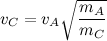
In words, the root of the ratio of the adult mass to child’s mass will give the factor describing how much faster the child moves than the adult. Practically speaking, this means my younger boy moves about twice as fast as me.
One may wish to assert that the above equation is obviously false because infants, as we all know, can’t move very fast. While they may initially appear to be an exception, it is useful to note that they make an awful lot of jerky, uncontrolled movements which would probably average to the correct mean velocity.
I have, on occasion, considered taking measurements to validate the theory, but I just haven’t had enough energy.


 I also blog at Engineer Blogs, home away from home to some of the best engineering blogs.
How to be condescending when you’re trying not to be February 9, 2014
Posted by mareserinitatis in career, family, societal commentary.Tags: career, children, mommy wars, parenting, SAHM
5 comments
There are few topics more fraught with angst than the mommy wars. A friend recently posted a link to a defensive volley from the stay-at-home mom court. Supposedly, this response was amazing.
I thought it undermined its own point.
Let’s start with the first paragraph:
The opener disgusted me immediately, and I almost quit reading. Let’s start with the fact that I agree with his main point: that women who choose one path over another (in this case, motherhood or career) are not necessarily superior to one other. However, the whole tone of the post was condescending toward women (and men!) and did ultimately end up being judgemental of working women.
But the opener set the tone, and the tone was that women are held to a higher standard than men. It’s okay for men to say stupid things about stay-at-home mothers (but not parents?), but women somehow have this innate, caring response that ought to be the first thing out of their mouths.
Sorry. It doesn’t work that way. I’ve been a SAHM and a working mom. People’s response to this is always one that comes from their perspective and takes no account of whether you’re doing what you want to or why. When I wanted to be a SAHM mom, people told me I needed to be supporting my family. When I didn’t want to be but was, people told me they were so jealous that I got to be at home. When I was working, people told me I was selfish and needed to pay more attention to my kids.
At all of these points, I was also told by other people that I had made the right choice. It’s funny how few people ever asked me what I wanted to do or if I was doing it. The reality is that, in each of these situations, I was doing what needed to be done for the good of my family, and each response had nothing to do with me and everything to do with the perspective of the person speaking those words.
When I find out someone is staying home or working, my response is, “How do you feel about that?” If they’re enjoying their current situation, a good response is, “Glad it’s working out for you.” If they’re not, I wish them luck in getting things sorted out so they can be more comfortable. It’s really not my place to say what’s best for them.
The post that started all this, however, didn’t. It came down firmly on the side of women needing to be stay at home moms.
No. It’s not as cut and dried as that. Some moms really don’t want to be home. Some moms are better being around other adults: being the sole caretaker for children with no adult interaction makes them depressed or anxious. (I believe this was covered in the 60s in Friedan’s Feminine Mystique.) I wouldn’t doubt that having mom home all the time may be advantageous for some kids, but I don’t know that it’s always the best choice for the whole family.
If mama ain’t happy, ain’t nobody happy.
If mom is going nuts staying home with the kids, I seriously doubt that’s the best situation for the kids, either. Having a depressed or anxious mom who views you as a toddling, diapered impediment to her happiness isn’t good for anything. What do we tell people to do if they’re unhappy with their job? Quit and find another because it’s not good to be in a stressful situation. Obviously, quitting being a parent isn’t an option, but finding time away from parenting certainly is.
The other thing that irritated me about this post was this:
Moms don’t need to be SAHMs to do this. In fact, what’s most irritating about this that you don’t need to be a mom at all: dads do this, too. This paragraph basically went back on the whole “I respect the choices that other parents make comment” and went ahead and tried to put those SAHMs up on a pedestal…doing exactly the thing to working moms (and ALL dads) that the writer was originally complaining about. In fact, he even says so.
No, I disagree. Parenting is a tiring, thankless, profoundly important job. And a lot of people have tiring, thankless, and profoundly important careers, too, although they at least usually get monetary compensation. Also, many people have jobs where they are greatly appreciated and are not easily replaceable. Okay, maybe someone who is only looking at your payroll may think so, but chances are that many of your coworkers don’t think that…even if you do get on their nerves.
No, I don’t think that mothers and children will be the only victims. I think the problem is simply how we treat other people in general. In general, we tend to be caught up in the “grass is always greener” syndrome without a realistic view of what other people are dealing with. Most people are really just trying to get through their day and don’t realize that they may be simultaneously in worse and better situations than the next person.
I once was very jealous of a friend because of all the academic honors he had achieved. He was so accomplished, and I felt like a failure next to him. One day he told me he felt the same because I had a happy marriage and a wonderful family. That was the day I realized that we all picked our own paths and had our own priorities. We always have to give up something to get what we want because no one has infinite time and resources. We almost always find the path of our lives takes unexpected twists and turns. And if people could respect and understand that, we’d all be in a better place. We’re not going to get there, though, by saying we respect all those paths and then telling someone they chose the wrong one.