Mom, could you homeschool me? December 15, 2014
Posted by mareserinitatis in education, gifted, homeschooling, younger son.Tags: acceleration, gifted, gifted education, homeschooling, parenting, school, younger son
add a comment
I knew we had to do something when, early in the school year, the younger son asked me to homeschool him. When I asked him why, there was the range of answers that included he’s not looking forward to losing recess when he gets to middle school, he’d like to spend more time with me (obviously we’re nowhere being a teenager right now), and even wanting to finish college at 14 or 15.
All I could think was, “Aren’t you supposed to be the easy one?!”
He is. Honestly, homeschooling him would be emotionally easy, but I’m not so ready to quit everything and become a full-time mom again. Or maybe ever. Not sure, and hope to never find out. The fact of matter is that he’s involved in so many activities that homeschooling him would involve me becoming a full-time chauffeur, and I know it would make me crazy.
On the other hand, he’s said he’s not sure he wants to leave school because he likes it and would miss his friends. After several discussions, he told me:
I think I need to write a pro and con list.
In the meantime, I’ve done a list in my head. First and foremost, he likes school. To me, that is the prime reason to keep him there. If he’s got a good thing going, don’t mess with it.
Beyond this, however, we’re discussing some academic acceleration for a couple subjects at school. I honestly do think that he’s better off staying where he is, but it’s also clear that the standard curriculum is not going to cut it. At a couple points, I contemplated whole grade acceleration, but I’m now opposed to this idea. I spent a lot of time reading through the Iowa Acceleration Scale material, and he has a couple things going against him: he’s already one of the youngest in his class, he’s small, and he’s athletic. Participation in sports is a major no-no if you’re going to bump kids up entire grades because this can have very real implications for the physical development and ability later on. I’m now certain that this would be a bad idea for him, and so subject acceleration in a couple areas seems to be the best solution. Fortunately, the school is, so far, open to discussion.
The other thing I’ve come to realize is that there’s really no hurry in getting through school. Is it really any better to go to college early and find a job early and lose that much time from your childhood? I realize that, for some kids, this is the only way to deal with the gap between mental ability and typical school pacing. Or maybe they are really that driven. I am fortunate in the fact that my kid doesn’t seem to require that level of acceleration, and I’d like to give him as much time as possible to explore his options.
I think, most of all, I want him to understand that there’s no reason to hurry up and get there, despite the fact that a lot of people think that’s somehow a sign of competence. I guess I’m starting to realize that no one really will care if he finishes high school in two years or four…just that he get there and finished. If he finishes in four, though, there’s the opportunity to explore more interests and do other things without the stress and expectations of adulthood weighing him down. Given the opportunity, there are a lot of other things I wish I could’ve done in my teens that aren’t an option now. I therefore hope he understands the value of taking his time: maybe he can learn to enjoy the journey.
Role with it December 12, 2014
Posted by mareserinitatis in education, engineering, work.Tags: communication, engineering, women in engineering, work
add a comment
I am always nervous when I have to deal with the middle and high school crowd. I’ve had such mixed results in the past. A couple years ago, I helped out with an astronomy workshop for middle school girls. My job was fairly easy: I just had to help them find the sun in some solar telescopes. It was pretty obvious, though, that the girls in the last group just weren’t interested and wanted to be done. That may have been the time of day, but they weren’t particularly subtle.
I was therefore nervous when I was asked to give a tour of my workplace to a group of high school girls. How in the world do I keep them interested?!
While we were waiting for the last couple people to turn up, I started out by asking where they were from. This was a good move: I found out they all went to my old high school, and so we talked about some of the teachers there. I think that having a way to connect was helpful for all of us.
It also turned out that they were already rather interested in the topic and had lots of good questions and comments. After I thought we were done, one of them asked another question which led us into another part of the building and looking at even more stuff than I had anticipated. They didn’t seem all that eager to leave at the end, and I’d wished I had more to share with them.
I know that doing tours is a formality, but it’s nice when the people are actually interested. It makes it seem less like work and more about conveying how exciting it is to be an engineer.
Biased for science December 10, 2014
Posted by mareserinitatis in feminism, geophysics, math, physics, science, societal commentary.Tags: bias, feminism, gender equity, iat, science, women in engineering, women in science
add a comment
I’ve taken a couple tests at Project Implicit. The premise is that we have unconscious biases that may unknowingly affect decisions we make about other people. I remembered this after coming across an article on race from the Washington Post. I’d taken a test before that said I had a bias against blacks. I’m owning up to it, but now that I’m aware of it, I try to recognize it’s there when making decisions.
I revisited the site to see if I could retake the test and if my results had changed, but I was distracted by the shiny things. In particular, I saw there was a test on the subconscious preference to associate science with male and liberal arts with female. Given the studies about how labs hire women less often and there is a subtle bias in salary, as well, I thought, “this could be interesting.”
And it was. I was expecting to show a rather strong relationship between men and science. Not only is that the most common association, but it seems like working in a male-dominated field would make that a no-brainer.

Your data suggest a moderate association of Female with Science and Male with Liberal Arts…
I’m one of the 3% who took the test who has that association. If what I read in the Washington Post article applies to this study, most of the people taking this test are younger, more liberal, and more female than the average population, so the test may actually mean that the 10% who associate females with science is actually an overestimate.
Why do I have that association, particularly working in the field I do? (I feel a bullet list coming on.)
Some potential ideas:
- Being a female scientist is a very strong part of my identity, so I would naturally equate the two. While at first guess, I would think this would be a no-brainer, the studies I cited above seem to indicate that’s not the case for most women scientists.
- I have a lot of female friends that are also scientists. As an undergrad, I was the only female physics major, but I made friends with a lot of female math, engineering, and physics and math education majors. In my MS program, I spent a lot of time with other women engineering students, the handful I could find. Going to a grad program (in earth sciences) means I was in a program with near gender-parity among the students. Through the beauty of the internet, I’ve also made friends with other women scientists. I think I’m likely to “see” more women in science than the average person…or even the average scientist. “Women in science” isn’t a token female here or there but an actual sizable demographic in my world. I think that this sort of exposure has probably had the most profound effect on my biases.
- I know a lot of men who are interested in liberal arts. Probably the most strongly influential one is older son, who is very much into drawing and writing. I spend a lot of time with him, so that also probably affects my perceptions.
I’m curious how others fare on this test as well as their analysis of their own results.
Faux-ntain of Youth December 8, 2014
Posted by mareserinitatis in photography.Tags: pictures
add a comment
I get the feeling that academics are very averse to photographs. I have to say that it drives me nuts that they will use photos (particularly on university web sites) that are obviously old enough to be middle school children.
I have had at least a half-dozen encounters with folks who, when I met them in person, were considerably more gray or bald or wrinkled or what-have-you than their online presentations would leave you to believe. Not just a little. Recognizing someone who went from having a lot of hair to none at all is a bit rough.
I do understand the desire to make a good impression or to having an attachment to a particular image of yourself. I also realize that photographs don’t always do the best job of capturing someone. I just wish it wasn’t so hard to recognize people at conferences.
Yo mama is SO stupid she can’t explain plate tectonics! December 4, 2014
Posted by mareserinitatis in education, feminism, science, societal commentary, teaching.Tags: children, communication, feminism, science, science education, sexism
2 comments
When selling something or conveying information, particularly when it is technical, one wants to make it easy and understandable. Unfortunately, one of the most common approaches I’ve seen is to say one needs to make it easy enough for an older woman to understand, particularly a mother or grandmother. One example of this issue was the IEEE article posted about the making of the Arduino that was erroneously titled, “With the Arduino, Now Even Your Mom Can Program.” They corrected it and apologized.
Last week, I came across another one about having a “grandmother talk.” Once people got upset about the sexist trope, the author changed it. However, it was more out of frustration because people weren’t paying attention to his main point about communication. (Note: if you piss off half of your audience with your title, chances are your communication may weak in certain areas.)
I don’t understand why they don’t just come out and title these things as such:
Yo mama is so stupid she can’t program an Arduino
Yo nana is so stupid she can’t science
I don’t think anyone would intentionally pick on grandma, but they apparently do so without realizing it.
The problem with using this terminology is that it assumes older women have no interest or ability when it comes to technical or complex information. Frankly, I’m pretty sure that, with the right instructions, both my mother and grandmother could handle a lot of technical topics. Being older females, however, people often assume that they are too ignorant to really learn things in depth. But despite myriad counter examples, the stereotype still exists. Some women really have little interest and ability in science, but there are also many, many women who are exceptionally talented scientists and engineers.
I have not yet seen, however, what seems to me a much better analogy: the kid talk. What if your kids ask you questions and you have to simplify it to be developmentally appropriate or to meet the constraints of a limited attention span?
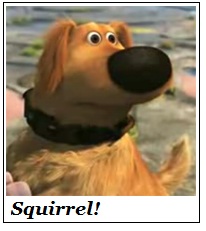
When I try to make things understandable to kids, I take the approach that there may be developmental challenges that they’re not ready to meet, such as a particular level of abstract reasoning. Perhaps they don’t yet have enough math to follow the technical details of a topic. There is also the reality that even the most mature five-year-old is not going to listen to me go on and on for hours about a particular topic, except perhaps Legos. The point of meeting them where they’re at is not because they are ignorant but because they’re inexperienced and uninformed. While I suppose a few would get offended at such a characterization, it also acknowledges that they’re capable of learning more once they’re a bit more mature or if they have a particular interest. It gives you some wiggle room, and you don’t have to stereotype anyone or be condescending.
I decided to put this into practice and once asked my older son to sit in on my classes. He would’ve been a year or two younger than most of the kids in the class, but being tall, he blended in very well. (It also helped that we don’t have the same last name.) I felt the information would be useful for him, but I also wanted to get his take on what parts were confusing or needed work. Beyond actually having a kid give you live feedback (because, let’s face it, they aren’t always available), it’s useful to even contemplate explaining concepts to kids.
There are a lot of marketing slogans to the effect of “so easy, a kid could do it,” but science and engineering communicators don’t generally seem to think this way. Part of the problem is that they don’t view children as a potential audience, even though I think they’re a rather important subset of most groups. I’m not saying you have to communicate on the level of a four-year-old, but an educated and curious 14-year-old will get you a long way. I wonder if science would be more interesting if we saw these kids as our intended audience in most communication ventures. At the very least, I’m sure there’d be more jokes.

Wordless Wednesday: There’s no place like 127.0.0.1 December 3, 2014
Posted by mareserinitatis in computers, photography.Tags: computers, pictures, wordless wednesday
2 comments

The luxury of a home-cooked meal November 30, 2014
Posted by mareserinitatis in feminism, food/cooking, societal commentary.Tags: celiacs, cooking, food, luxury
add a comment

The best dressing you’ll ever eat.
The other day, I had a discussion with someone who was complaining about something related to fast food. I jokingly said that one way to avoid the problem was to, “You know, buy food at the store and cook it at home.”
That’s a luxury I can’t afford. I don’t have enough time to do that.
I have to admit this comment really got under my skin a lot more than I expected. The primary issue I have with this is that the real luxury is having the income that allows one to purchase precooked meals on a consistent basis. Claiming that cooking food at home is a luxury makes it sound like it’s something I get around to as a way to relax after having bon-bons and a massage on the couch while watching reruns of Quantum Leap.
The other reason it got to me is because I have no choice. Since being diagnosed with celiac disease, I have discovered there are only about three restaurants in the city where I feel comfortable eating. I cannot eat over at friends’ houses because most of them don’t understand the dangers of cross-contamination. Even a crumb of gluteny food leaves me in pretty bad shape for nearly a week. I imagine a lot of people think this is hyperbole; I wish it was.
I have no choice but to cook almost everything I eat. I cannot buy prepackaged foods. If I am lucky enough to find ones I don’t react to, they are priced to cost nearly twice as much as an equivalent food containing wheat. I can’t afford that. In fact, most people I know can’t.
This comment left me feeling like somehow my time is less valuable than this person who said it. Cooking is most definitely work, and it’s time-consuming work, as well. It’s bad enough that domestic work has been ignored in economic terms forever, but now we’re trying to rebrand it as a luxury?
Wordless Wednesday: Why did the turkey cross the road? November 26, 2014
Posted by mareserinitatis in photography.Tags: pictures, turkey
add a comment


The runner’s physique November 25, 2014
Posted by mareserinitatis in running.Tags: health, physical activity, runners, running
add a comment
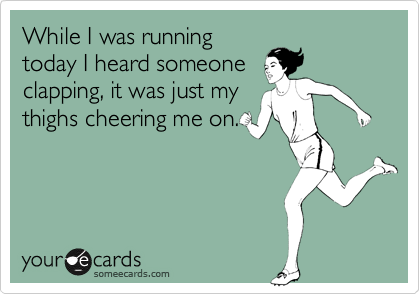
I have been running just over three years. It’s been a struggle because I’ve had problems here and there, but I’ve kept it up. In the past year, I ran a marathon relay, two half marathons, and the run leg of a sprint triathlon. I occasionally do 5ks, as well. I think this means I am officially a runner.
The problem I’ve run into a couple times, however, is that people simply can’t believe I run because I don’t have the “runner’s physique.” Yes, not all runners are skinny and fast and muscular…not even ones who’ve been doing it for years, who watch what they eat, who train religiously.
A runner can and does have myriad body shapes and fitness abilities. If you’ve ever participated is a really big race, you can see the whole spectrum of runners from the ultra-skinny to the ultra-heavy. In fact, a good way to tell if someone runs in actual races is whether or not they are cognizant of this fact. Running is not a slam dunk, and once you begin doing it, there is no guarantee that you’ll lose weight. In fact, in talking to several runners I know, many of them find that they gain weight when training for longer distance races. I’ve seen people who are larger than I am but have done dozens of marathons.
That isn’t to say it can’t be done, but I guess the frustration that someone who is active and health conscious will be skinny is very simplistic. It certainly doesn’t take into account a lot of other things, the major one being life. That’s right: life is stressful and you don’t get enough sleep and you have kids to chase around and you can’t always eat as well as you’d like or you do and you’re ill or what have you. Life gets in the way, and I think it’s awesome to see anyone of any size, shape, and physical level get out there and move…slow or fast.
The experience I had most recently in this regard was one I’ve run into a lot: doctors who jump to the conclusion that you’re not very active because of your size. It’s noticeable in the types of treatments they recommend for problems, and in my experience, can seriously inhibit the process of getting a good diagnosis for just about any type of problem. However, I managed to learn a lot of new facts about Drug treatment and other similar topics.
I encountered a new internist recently who was involved in a conversation with myself and another person. This other person and I started discussing a race we’d both been to before he had to excuse himself. The internist and I chatted a bit, and she exclaimed she was really surprised I’d done a half marathon. Unfortunately, I was not surprised by her surprise because this is a reaction I get all the time. All I can hope, however, is that she will take this back to her practice and not make the assumption that people who aren’t skinny are also not physically active.
In fact, it’s an assumption I wish we could get rid of. All of those concern trolls who claim to worry about people because of their weight need to be more concerned about their own ignorance regarding the spectrum of body types. We all need to remember that you can’t tell much about a person just by looking at them.


 I also blog at Engineer Blogs, home away from home to some of the best engineering blogs.
How to fail as a skeptic December 16, 2014
Posted by mareserinitatis in religion, science, societal commentary.Tags: atheism, research, science, skepticism
2 comments
A few months ago, I wrote about my experience attending an atheist meeting. If you don’t want to read it, I basically spent most of the time dealing with an argumentative jerk. On the other hand, I expected that going in.
Part of the reason I expected that is because there is a large amount of cross-over between the atheist and skeptic community, and I’m slightly more familiar with the skeptic community. My husband has been a member of CSI before it was called that, and we regularly get into conversations about articles we read in Skeptical Inquirer. I also used to follow a lot of skeptical bloggers. Frankly, the more I read and interact with skeptics, the less impressed I am.
My latest interaction with a skeptic just reinforced much of what I already felt (and commented on at the atheist meeting). There is a sense among most skeptics that they are well-educated and rational and therefore whatever they happen to believe MUST hold up under scientific scrutiny, whether or not those facts have actually been researched. If you come across one who has done the research, it’s likely they’ve done it in a way that has fallen victim to massive amounts of confirmation bias: choose the studies you like and discredit the ones you don’t. Many atheists and skeptics don’t realize that confirmation bias occurs regardless of IQ and therefore they are just as prone to it as the folks they like to condemn as stupid.
If you try to argue the actual studies and data, you get responses like this:
I am particularly amused when such comments come from non-scientists.
The quote above comes from someone who writes for Skeptical Inquirer, and while it wasn’t aimed at me, it was directed at someone who has better scientific credentials than the person who wrote that comment. In another conversation with this person, similar comments were directed at me.
The crux of the matter is that this person simply would not hear any interpretations of data other than the one they wanted to. I’m sorry, but that’s not skepticism. Questioning data (on both sides) is a useful exercise to help you understand the limitations of such data, and it’s good to understand where data is useful and not. However, being a skeptic does not mean you can throw it out if you don’t like it. That means you’re a denier, even if you do have some scientific evidence for your viewpoint.
It’s interesting that CSI recently posted an article complaining about how the media misuses the term skeptic when it really means denier. (Deniers are not Skeptics) I agree with the sentiment, it also is a bit ironic because so many of the people I’ve interacted with really are better described as deniers.
One of the hallmarks of scientific thinking is supposed to be comfort with ambiguity. It’s learning to say that one cannot extrapolate beyond the data one has, and drawing large-scale conclusions based on a handful of studies is really not scientific. I’m not talking about things like climate science which has been extensively studied for decades and has a wealth of data (and believe me, I get frustrated enough myself dealing with deniers on that topic): I’m talking about a lot of other topics which have not been as extensively studied and suffer from shifting understanding. Taking studies from even 20 years ago can be problematic in some areas because the basic assumptions and approaches may have shifted as new data comes out. And in a lot of areas, particularly with those dealing with people, studies may not always have data giving a clear and decisive answer to one view or another. (Confirmation bias can also mean that people will take ambiguous data as backing their own viewpoint.)
This lack of comfort with ambiguity and the notion that one’s reasoning trumps the data means that having a conversation with these folks is more like a wrestling match: it’s not really a discussion or exchange of ideas but an argument where there is a winner or a loser. Any one who tries to recognize nuance in the data or discrepancies is said to have lost the argument or not understand science and how it works. Frankly, I’ve had more fruitful conversations with fundamentalists.
If you want to call yourself a skeptic, that’s fine. But if you use it as a bludgeon to convince yourself and everyone around you that your view is always right…well, don’t be surprised if I’m a little skeptical.