Extra-dimensional conversations October 13, 2014
Posted by mareserinitatis in physics, science, younger son.Tags: alternative universes, calabi yau, dimensions, physics, spacetime, younger son
add a comment
The younger son occasionally has band lessons after school. Recently, I picked him up and he said that his band teacher hadn’t been in her office when he was supposed to have his lesson. The next comment surprised me.
You know, in an alternative universe, I forgot my instrument but she was in her office. And then there’s other universes where I had my instrument and she was in her office and others where I forgot my instrument AND she wasn’t in the office.
Apparently he has combinatorics licked.
I was somewhat surprised at this response, so I asked him what he knew about other universes.
Not much. I just know you use wormholes to get between them.
I responded that wormholes are supposed to transport you across time and space, but wasn’t sure if the strict physics definition allowed for travel outside of our universe.
Mom, wormholes transport you across dimensions!
This made me wonder if he knew about M-theory. When I asked him what he knew about higher dimensions, he said,
Well, they’re really similar. But after a short time, you notice differences.
I was confused, but he continued.
And some dimensions have aliens and some don’t.
Ah! His definition of higher dimensions was basically an alternate universe. He was working with the ‘sci-fi definition.’ I needed to change terminology, as we obviously were discussing two different things with the same word, so I said the world we live in has three spatial dimensions and time as the fourth dimension.
Time is a dimension?!
He understood and explained the concept of two dimensional space and then three dimensional space, but he was perplexed about time as a dimension. My explanation was that you can move through time, but only forward. With the spatial dimensions, you can move forward and backward, left and right.
I think I blew his mind at that point, so I figured we’d drop it and move on to Calabi Yau spaces another time. In the meantime, I’m trying to decide if I should introduce him to Abbot’s Flatland.

I need to brush up on my theoretical physics. http://simple.wikipedia.org/wiki/Calabi-Yau_manifold#mediaviewer/File:Calabi-Yau.png
Running with kids…or maybe from them September 7, 2014
Posted by mareserinitatis in family, older son, running, younger son.Tags: older son, running, younger son
add a comment
Even a couple years ago, it was hard to get a workout in once the younger son was home. I was lucky in that the older son is a bit of a homebody and could watch his brother if Mike wasn’t around.
Now, however, I have a new dilemma. The younger son has decided he’s over this “kid’s race” stuff and wants to start doing 5ks. The older son likes doing 10ks. I’m currently training for my second half marathon this summer. How am I supposed to train with my kids??! They’re not terribly motivated to train on their own, but they like going with me. I suspect this is because I turn into a zombie when I run so the kids have my undivided attention and I don’t say much. They can speak unimpeded for a long, LONG time. On the other hand, they like doing races because of the freebees. However, training with them on top of my own running is a bit too much, so I started to get creative.
This morning’s training run was 12 miles, so I decided to break it into a loop of three miles. I did one loop by myself, ran the loop twice after that with the older son (who is starting to have a hard time keeping up with me), and did it one more time with the younger son (who apparently decided after a mile that we needed to walk…and my feet agreed with him).
This worked great because I also found out that this eliminated the need to find gas stations along my running route. Unfortunately, gatorade bottles don’t sit nicely in my race belt. Also, my husband wasn’t expecting me to try to give him a sweaty hug until the end (doesn’t everyone do this to their spouse?), and I was able to nab him mid-route. He still went and got me some post-run celebratory ice cream, so I guess that was okay.
I just imagine that there were some people scratching their head as I walked past for the fourth time this morning…
Cooking up a storm August 31, 2014
Posted by mareserinitatis in family, food/cooking, older son, younger son.Tags: chores, cleaning, cooking, housekeeper, older son, younger son
add a comment
I have to admit that I think we’ve finally got the hang of this whole cleaning/cooking thing. A while back, I mentioned that we’d gotten a housekeeper. That lasted for almost a year, but then we decided that it wasn’t working as the housekeeper couldn’t keep up. I suspect it’s because of the overload of fuzzy creatures.
We changed tactics: basically, we just pick a time every weekend to spend a couple hours cleaning (although it doesn’t work so well when we’re gone for multiple weekends in a row) and we all spend an hour or two working through the list. Each item on the list is worth a certain amount, depending on the effort involved, so this is what the kids get for an allowance. I think we spend 1-2 hours every week cleaning, and while the house is more cluttered than I like, it’s actually staying reasonably clean. Also, I no longer have to spend tons of time instructing the kids on how to clean the toilet AGAIN since it has only been a week or two since it was last cleaned. (Our biggest problem comes in the fact that every one likes to put the cleaning supplies in different places…)
In the past year, though, I found that I am sensitive to even tiny amounts of contamination in a lot of gluten-free foods, and this resulted in a shopping list that involved almost no processed foods. The amount of time I spent cooking increased drastically, so I recently decided to try this same approach with cooking: the kids now spend about an hour in the kitchen getting dinner ready or helping with other things (baking bread, making snacks) 3-4 nights a week.
It’s only been a short while, but this seems to be working, too. I’m not sure why I never tried this before, although I suspect some of it is that I was nervous about the younger son handling certain cooking activities, particularly those with knives. (I have to admit that I still give a lot of those chores to the older son.) He loves to bake, though, so as long as I get the ingredients out for him, he’s getting pretty good at following recipes. He makes a pretty mean beer bread…(with gluten-free beer, of course).
I’ve been very surprised how positive their attitude about this has been, particularly since they don’t get allowance for this. (It wasn’t quite pitched as, “You don’t help, you don’t eat,” but I think they understood that my frustration was almost to that level.) However, I uncovered another reason why this may be working: I suspect the real motivation is that they’re tired of waiting for me to make their favorite foods. The baking, in particular, tends to be put off in favor of making dinner. They must’ve realized that if they learn to do it themselves or help take care of some of the other cooking chores, they don’t have to wait as long. I have to admit that if there’s something they really want to cook, I’m not inclined to say no.
Oh, that’s right! I have a blog! August 29, 2014
Posted by mareserinitatis in family, grad school, older son, personal, work, younger son.Tags: dissertation, older son, school, work, younger son
add a comment
Summer, at least the social construct of summer, officially comes to a close this weekend for most people. The younger son has been in school for a week, and I’m scratching my head, wondering where the time went. It was the summer of “the best laid plans of mice and men,” if you get my drift.
I did accomplish a lot at work. However, shifting deadlines there required I push off other stuff. In response to that, I decided to take some time off and get caught up on some of those other things, which will be easier now that the younger offspring is busy plodding through the halls of a reputable educational institution rather than ones created in Minecraft. I have a couple weeks of crunching numbers at home before going back to work to do it.
The other thing that will help is that the older offspring has decided that his odd work schedule really isn’t doable, despite a serious effort on his part. I am relieved because I seem to be getting more sleep again, which has made me a saner, kinder, and more productive human being. Also, I appreciate being able to form a coherent sentence…
I hate to say it, but I’m glad school has started again. I usually love summer, but I’m very glad to have a routine and time to work on my own stuff back.
How was your summer?
Greener pastures August 11, 2014
Posted by mareserinitatis in personal, photography, younger son.Tags: birthday, grandmother, horses, medora, younger son
4 comments
I don’t know about you, but sometimes I have a hard time figuring out how to celebrate birthdays. Some years, you just go out to eat, or sit around the house, or hope someone makes your favorite meal. This year has been rough because of everything I have on my plate right now.
Milestone birthdays are important in an odd sort of way, so I try to do something extra fun, and it’s important to take those opportunities when you have them. On this occasion, I thought maybe riding a horse with my grandmother and the younger son would be a cool adventure. I’d never been on a horse before.

The ride was an hour-long, guided trail ride in Medora, ND. You can see Theodore Roosevelt National Park in the background, so the scenery was fantastic. I found out that horses scare me a bit, and that you shouldn’t pat them on the rear flank the way your dogs like their people to do. (Apparently I almost sent my horse over one of the guides while she was trying to remove his halter.) After the ride, I found out that my grandmother had used to love riding horses in her younger years, but hadn’t been on one since my mom was a little girl.
It was a great way to celebrate my grandmother’s 85th birthday. I hope we can keep having wonderful adventures together for a long time. I just hope she doesn’t want to go sky-diving any time soon…
The competitive spirit July 24, 2014
Posted by mareserinitatis in family, younger son.Tags: competition, sports, younger son
add a comment
I have often joked to the older son that I learned, far too late, that I didn’t have to do everything perfectly: I just had to do it better than everyone else.
While that statement reeks of hubris, it comes with an extremely large side of truth. More importantly, it was something that enabled me to get over my perfectionistic tendencies and just get things done…because I would never find out if I did it better if I never did it at all.
That never-doing-it-at-all thing is something that keeps showing up with both of the kids. Both of them have this huge fear of not doing things perfectly, and it will keep them from even attempting. I do realize that both of them grew up comparing themselves with the adults around them as reference points, and knowing they can’t do things as well as much older adults has had a pretty lousy impact on what they perceive as success. That is, no effort will ever be good enough to compare to the adults, and they want to give up before starting. (I have wondered if this would be different had they been closer in age, but that’s an experiment for an alternative universe.)
I discussed earlier how the older son is fighting with perfectionism in his classwork. The younger one has had a related set of challenges. His, however, center around sports. He is in two somewhat related sports, the second one showing up as a desire to improve his skills in the first. Earlier this year, he was told he could move up a level in the first sport. He has repeatedly told me he doesn’t think he wants to because he wants to get the current level “perfect.” Once I heard the word perfect, I decided it was time to move him up. He has no idea that he’ll never really get it perfect, and that sometimes the practice to get better comes from starting to master more advanced skills. Given he has complained about going over basic skills that he knows inside and out, it’s definitely time to move on. I’m just waiting for the complaints, however, that the next class is too hard. He often forgets that the hard things become easier with practice.
In the second sport, we started looking at another training facility, and someone asked about evaluation for the competitive team. The younger son immediately said, “I’m not competitive.”
I’m going to be honest: I’m a pushy mom. I’m not one of those moms that expects their kids to be perfect at everything. I’m not one of those moms that signs her kids up for everything regardless of their actual interest. I am, however, one of those moms that wants her kids to push themselves. This, to me, was bald-faced fear that was going to prevent younger son from even trying. He was afraid he wasn’t going to measure up to the other kids, so he wasn’t even going to try. In doing so, he’d never learn to push himself.
Unacceptable.
However, forcing him to go through the eval without any interest is not the solution, either. He would intentionally flub it if he didn’t absolutely refuse to do anything at all. (It doesn’t take much to figure out that would be the end of it.)
I spent a lot of time thinking about how to discuss this with him, and I finally settled on telling him a couple things that I wish I’d known when I was younger. I suspect it would’ve completely changed my view on sports, as well as academics…and, well, on life. (And it’s a much healthier viewpoint, IMO.)
First, I said that if the coaches think he’s good enough to be on the competitive team, he really ought to try and see how it goes. If he has a talent that he’s interested in developing (and he has expressed the desire to learn to do this stuff really well), then he will move a lot farther along with some good coaching. I also told him that the coaches are the best judge, and if they don’t feel he’s good enough for the team, that’s okay: he can still go to lessons and keep learning. He just won’t get in as much time to develop this skill as if he were able to make the team. If it’s still fun, he should keep doing it regardless of what the coaches think.
Second, and far more important, is that being on a competitive team does NOT mean that I expect him to go and win awards and beat people all the time. Being on a competitive team means that I expect he will work hard to improve his skills. The only person he’s really competing against is himself. If he happens to win awards doing it, that’s great, but that’s not required. He just has to want to work hard to improve himself and to keep improving. It’s about learning how to work hard to become better at something.
I know that coaches are evaluated on how many of their protege do just that. Unfortunately, that’s reality, and so I think coaches are smart enough to spend time on people who they know will be able to become really good. Therefore, if they don’t see the talent, I doubt they’re going to want to spend much time on that particular student.
I also know that, in the back of my head, there are people who think competition is beating everyone else. I’ve seen the uber-competitive parents at various sports throughout the years, and they bug the heck out of me. The idea that it’s about winning is a thought that robs a lot of people of the joy of doing things and making them better people. I did a triathlon a few years back that brought that front and center: if I had done it to compete, I would’ve never started training. After I finished, dead last, no less, not only did I not care that I didn’t place, I didn’t care that I was last. I accomplished my goals and did something that I’d never done before (and that many people thought was extremely crazy to attempt), and that was far better than winning an award.
There is an inherent satisfaction that comes with mastery of a particular skill that has absolutely nothing to do with what other people think or compare. Pushing yourself within healthy limits and without regard to what the rest of the world thinks is very rewarding, and, to me, makes almost any endeavor worthwhile.
Rhubarb, white, and blueberry muffins (gluten-free, dairy-free) July 2, 2014
Posted by mareserinitatis in food/cooking, photography, younger son.Tags: baking, blueberries, cooking, muffins, recipe, rhubarb
add a comment
No one in our house likes rhubarb. It’s one of those things that all the German grandmas would bring to church potlucks, and my parents would say, “Isn’t this great!” Meanwhile, my face is about to implode from puckering.
My worst experience was in high school. I had a crush on someone, and when I went to visit him, his mom made rhubarb bars. I had to impress this boy’s mother, so I didn’t say how much I hated it. No, I suffered through the whole bar, eating every last bite. Later, he decided he didn’t want to date me, and I realized that if he couldn’t appreciate how much I’d suffered, he obviously wasn’t the one for me. No man is worth eating rhubarb for.
I was glad, therefore, when I met Mike, and in one of those deep, get-to-know you conversations, I found out he disliked rhubarb as well. He comes by it genetically: his dad hated it so much he would change oil over the rhubarb plants in their yard.
Therefore, when I opened our CSA box last week and saw three pounds of the stuff, I thought, “Oh, crud.” Actually, I thought something else, but I’m too polite to say it in a blog post. I tried to pawn it off on my parents, but no luck.
Anyway, I spent some time pondering and decided to at least try it. I won’t eat tons of it, but I concocted a recipe that uses a tolerable portion. And the rest of the muffin is so good that I don’t mind eating around it. I also discovered that the smaller the pieces that you chop it into, the less intense the flavor. (Now, if you really like rhubarb, cut it into big pieces and substitute a half cup of rhubarb for the blueberries.) I figured it must be okay since the younger son, who is the food critic of the house, really enjoyed them.
And since the Fourth of July is coming up, it seemed appropriate to give it a patriotic theme.
Rhubarb, white, and blueberry muffins
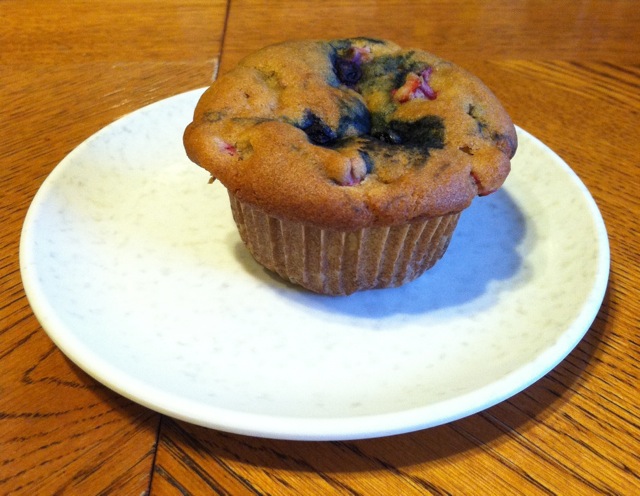
Rhubarb, white, and blueberry muffin
Makes 12 muffins
Dry ingredients
- 2/3 cup sugar
- 1 1/2 cups gluten free flour (if you like to blend your own, I’d use 140 gms or 1 cup white rice flour, 46 gms or 1/3 cup potato starch and 26 gms or 1 tbsp + 2 tsp tapioca flour)
- 1/2 tsp baking soda
- 1 1/2 tsp baking powder
- 1/4 tsp salt
- 1/2 tsp xanthan gum (leave out if using a flour mix that includes this)
Wet ingredients
- 1/2 cup + 2 tbsp butter (for dairy free, use coconut oil)
- 2 eggs
- 1 cup buttermilk (for dairy free, use 1 cup full-fat coconut milk from the can (I like Thai Kitchen brand) + 2 tbsp lime juice)
- 1 tsp vanilla extract
- 1 cup diced rhubarb
- 1/2 cup blueberries
Instructions
- Preheat oven to 350°F.
- Place muffin papers in muffin tray or grease and flour muffin tray.
- In a medium bowl, combine thoroughly all dry ingredients except sugar and set aside.
- In a large bowl, cream butter (or coconut oil) and sugar together. (If using coconut oil and it’s liquidy, I suggest sticking it in the fridge to let it solidify. Cool coconut oil works much better for this. If you’re still not having much luck, go to the next step, using cold eggs, but mix for much longer and it will cream.)
- Add eggs and mix for another 20-30 seconds.
- Add buttermilk (or coconut milk and lime juice), vanilla, and dry ingredients and mix until thoroughly combined.
- Add rhubarb and blueberries and stir until evenly distributed. (Note: I prefer using fresh blueberries because frozen tend to ‘streak’ the muffins. If all you have is frozen, though, pull them out right before you’re going to add them and toss to coat them with some potato starch.)
- Distribute batter into muffin tray.
- Bake for approximately 28 minutes.
- Let cool in pan for about 10 minutes and then move to cooling tray.
A Rite (Triangle) of Passage May 13, 2014
Posted by mareserinitatis in education, family, gifted, homeschooling, math, older son, teaching, younger son.Tags: homeschooling, learning, learning styles, math, pythagorean theorem, visual-spatial, younger son
1 comment so far
 The younger son recently started his pre-algebra class. Somehow, this has made math a bit better. I think the fact that it has algebra in the title makes him feel very accomplished and that, in turn, has made him more enthusiastic about math.
The other day, he was doing some of his homework, and the lecture was confusing to him. I listened to the lecture and then said, “It makes more sense if you draw a picture.” He responded that, “Pictures always help me learn better. I guess the math program doesn’t realize that some of us are visual learners.” I was both amused and quite stunned. I think I’ve been discussing educational theory a bit too much at the dinner table. I can tell he’s listening to us.
Tonight, he hit a milestone. He called Mike over, and I followed, so he could ask us how to pronounce “pythagorean.” He was sure he’d heard us talking about it before (yeah, we discuss this stuff around the dinner table), and he wanted to be sure that was what it was.
“Oh, wow!” I said. “You’re doing the Pythagorean Theorem. That’s awesome!” Suddenly, there was an impromptu round of cheering and high-fiving. The older son even came over and gave his little brother a big hug, saying, “Woo hoo! The Pythagorean Theorem is awesome.”
As the lecture progressed, it reiterated the terminology, focusing on right triangle legs and hypotenuse. Given I’ve had ZZ Top in my head, I had to immediately sing, “She’s got legs! She has a hypotenuse!” I wasn’t able to come up with much more, though.
Yes, I have to admit that I realized how odd it was, in retrospect. We were having a celebration that younger son had made it to the Pythagorean Theorem, and we were all making a huge deal about it.
But younger son didn’t think so. He thought it was awesome and giggled continuously for the next few minutes. I guess he likes having a math cheer team.
My child is… January 30, 2014
Posted by mareserinitatis in engineering, younger son.Tags: patents, sticker, younger son
add a comment
My second patent application went in a couple weeks ago. My first was filed about a year and a half ago, and I still haven’t heard on that one.
Anyway, a couple days after the second application went in, this sticker showed up in the mail for the younger son:

Is it horrible for me to admit that I seriously considered cutting off the “My child is a” part and sticking it to my car?
I hope I’m not being overly optimistic.


 I also blog at Engineer Blogs, home away from home to some of the best engineering blogs.
A filtered education March 3, 2014
Posted by mareserinitatis in education, homeschooling, math, older son, physics, science, societal commentary, teaching, younger son.Tags: light, older son, physics, science, science education, teaching, younger son
add a comment
The older son is a lot of fun. Despite his statements that he has no desire to go into science, he seems to get and make a lot of science jokes. I know he’s not a scientist, but I feel comfortable that he’s scientifically literate. As he was homeschooled, I’m feeling pretty proud of myself.
I’m more anxious about the younger son, though. This weekend, he brought home his science homework, which focused on optics. The kids were studying filters, and one of the questions asked about what kind of light would you see if you shined a flashlight through a blue filter and then a red one. I asked him what he saw, and he said nothing. Unfortunately, he was told that he saw nothing because the flashlights just weren’t bright enough, but that what he should have seen was purple.
I’m pretty sure that if I had ever been bombarded with gamma rays in the past, I would’ve turned into She-Hulk at that very moment and started smashing things. Fortunately (or unfortunately, if being She-Hulk happens to be a goal of yours), that didn’t happen.
I find it infuriating that, throughout my years of homeschooling older son and teaching younger son math, I have constantly been questioned about my ability to teach them. The implication has always been that I may have a degree, but they are experts on teaching. In fact, this particular teacher attempted to take me to task earlier this year about the younger son’s math curriculum…the same teacher who apparently doesn’t understand that light and pigments work completely differently.
After I managed to calm down, I explained that light filters are like sieves, except that they only let one size of particle pass through: nothing bigger can pass through the holes, but nothing smaller can, either. After this explanation, the younger son was able to correctly explain that the reason he saw no light from his flashlight is that the two filters together had blocked all the light.
I’m going to be watching very carefully to see what kinds of scores he’s getting on his answers and whether the teacher realizes she made a mistake. This was very disappointing. There was a new science curriculum introduced this year, one which I was very excited about. The focus was supposed to be on hands-on, problem-based learning, which is great for science. Despite that, it seems that younger son’s science education may be lacking. What good does it do to have a top of the line science education curriculum (or math…or anything else) when our teachers don’t understand what they’re teaching? And how is it that these same teachers can justify questioning the ability to teach material that some of us understand far better than they do?