Not working… October 4, 2012
Posted by mareserinitatis in education, gifted, math, younger son.Tags: gifted, gifted education, math, younger son
3 comments
Last spring, we came to an agreement with the younger son’s school that he’d be doing his online math course at school.
We didn’t even make it a month, and he’s back to doing it at home. I’m not sure what happened, but it sounds like he couldn’t work in the classroom. Instead, he was supposed to work out at the main desk. I’m sure that wasn’t at all distracting. He had some people there he could ask for help, but I get the feeling that didn’t work so well and they also weren’t going to let him contact his teacher through the program. He basically stopped working.
After a few days of this, I started doing some of it at home with him after school. Finally, it was apparent he wasn’t getting anything done at all at school, so we sent a note to his teacher and the principal that he would be doing math at home again. His teacher said ok, and the principal never responded.
I’m not sure what to make of it given how adamant they were about him doing his math at school last spring. I also guess I’m a bit disappointed that I have to take this over again. However, it seems like he’s moving again, so we’ll just go with it.
Students finding their direction June 23, 2012
Posted by mareserinitatis in education, engineering, geology, geophysics, physics, research, teaching.Tags: engineering, geophysics, majors, math, physics, students
add a comment
The younger son’s birthday was this week, and we opted to host a pool party at a local hotel. (IMO, pool parties are the best for the elementary school age group: they keep themselves busy and then go home exhausted.) I was checking in when I noticed a young man standing at the other end of the counter. He looked familiar, so I asked if I knew him.
“I took your class last fall.”
“Oh great! How did the rest of the school year go for you?”
“Great. I actually switched to business and am really liking it.”
“Really? Why did you switch?”
“I just figured I liked business a lot better.”
“That’s why they have you take those early major classes – so that you find out you don’t like it before you get too far into it.”
I think the poor kid thought I would be mad that he had switched. But I wasn’t mad at all. If he feels like he’d be better off in a different major, then he ought to go for it. And that is part of what I’m trying to set out in the class – this is what engineers do. If it doesn’t look fun, then you ought to think about a different major. That’s a perfectly valid choice, and no one should judge a student for it.
(Yeah, I know…I sit here and wring my hands because older son gets these obnoxiously high scores in math and science but wants to be a writer…I’m one to talk.)
But seriously, I actually think it’s sort of silly to make students choose a major really early on in school. I think it’s a good idea to try to take a lot of classes in different fields before you really choose. I say this as someone who major hopped a lot during undergrad. I spent some time in physics, chemistry, journalism, and graphic arts. I finally decided that I liked physics after all, but what got me excited was geophysics. I happened to take a geology class when I was at Caltech because I had to take a lab course, and everyone told me geology was the easiest. Turns out, I really liked it and did very well in the course. (Of course, later on, I found that geology feels too qualitative and prefer geophysics, so it all worked out. On the other hand, I think I would’ve liked geology better if it had all been field courses.) :-)
I have run into people who got upset with me for this type of thing. I was doing research with a professor in undergrad, but I felt like the research wasn’t going well and got sort of excited about a math project that I’d seen a professor give a talk about. I talked to that professor to see if he’d be interested in having me as a student, which he was. When I told the other professor that I was going to work with the math professor, all hell broke loose. (I still think I made the right choice, though, especially since the first project really never did go anywhere.) I have yet to figure out why the first professor got upset, though, and did some petty stuff, like kicking me out of the student office (despite no one needing a spot) and having the secretary take away my mailbox. (This was silly, BTW, as I was president of the Society of Physics Students, so she ended up giving it back to me a month later so I could get SPS mail.)
And what did this do? Certainly reinforced that I didn’t want to work with this person, but I could also see it making a student feel like this person is representative of a particular field. Wouldn’t you wonder if a student would not want to go into a major because of the way the professors treat him or her? I can (and did!), and it just shows how ridiculous the whole thing was.
No, students need some time to explore their interests and getting mad at them for not doing what you think they should do is silly. They are the ones who have to deal with the consequences of their choices, and if a student takes my class and decides they don’t want to spend the next five to ten years of their life studying engineering, then I think they’ve learned something very important and just as valid as anything else I have to teach them.
What have I done?! June 21, 2012
Posted by mareserinitatis in education, engineering, papers, research.Tags: math, minion, textbooks
add a comment
(As I sat down to write this post, I realized I have a dilemma tangential to the point of the post. The Minion is officially no longer a minion, given he’s finished his undergraduate education. Formally, he’s been upgraded to a henchman. However, if I start calling him the Henchman, I realize no one will know who I am talking about. Therefore, I shall continue to call him the Minion, but please try to remember that his rank is officially that of a Henchman.)
A couple days ago, the Minion asked me for help on something. He’s doing some work on a topic with which I have very limited knowledge. (I consider this sad because it’s something I have interest in but little time to explore.) However, what he needed help on was a mathematical aspect. After finally getting a handle on what he was doing, we sat down and came up with a way to solve his problem. Mike came in and overheard us talking and suggested there may be a paper in what we’re doing. The Minion thought it would be interesting but wanted to talk with someone who has more knowledge of the field (as I obviously don’t), and he was going to check with someone he knows.
I sat down and spent an hour writing out the formal mathematics for the problem so that it would be easier to present this to someone. It looks very pretty (especially since I did it in LaTeX). However, I couldn’t help thinking, as I proofed it, that I managed to take what, to me, seemed like a straight-forward approach to solving the problem and obscure it with symbology.
I think I could potentially have a career writing textbooks.
Why parenting sucks… May 25, 2012
Posted by mareserinitatis in education, gifted, math, teaching, younger son.Tags: education, gifted education, math, standardized exams, testing, younger son
11 comments
Now that the school year is over, I can finally discuss one thing that’s been driving me nuts for the past couple weeks.
Most of you know that I’ve been volunteering to work with a group in my son’s class that’s slightly ahead in math. The teacher was doing some grouping to help the kids who were struggling and more or less leaving the other ones to do “enrichment activities” for an additional twenty minutes outside of normal math time every day. I was going in once a week to help with the advanced group, although that evolved into reading math stories to the whole class every other week.
One day was very odd. As I sat down to work with the ‘advanced’ group, the younger son started talking. He started explaining addition and multiplicative identities to the other kids, but it was obvious they didn’t know what he was talking about. At first, I tried to get back to what I’d planned on discussing, but I also didn’t want to make him feel like he was being shushed. So when the other kids started this eye-roll, “here he goes again” type of body language, I tried to augment what he was saying. I wondered how often this type of thing was happening. I felt bad about the whole thing because the kids seemed interested when I was talking about it. However, here’s the younger son, feeling like he can talk to these other kids about some of the math he was doing at home, and they don’t understand and are blowing him off.
Unfortunately, I know how he feels because this happens to me as an adult, almost always when I’m talking to my kids’ teachers. I have always gotten the feeling that they think I don’t understand children or how they work. I obviously am just one of those parents that’s overestimating my child’s intelligence and pushing him beyond his ability. If my children really were ‘gifted’ (always said with a sneer, if the dreaded word is even spoken at all), then they wouldn’t behave the way they do. (I think this means they expect my kids to sit still and be compliant.) And I’m most definitely not competent enough to handle educating my own child.
In fact, it happened again very recently. The younger son’s end of year test scores came back, and all of the focus was on one subtest where he’s “right in with his peers”. That is, a full year ahead of national norms. They’re very concerned about his progress because of that subtest and wanted him to spend next year in the normal classroom to ‘get him back on track’. (Because working a year behind his current achievement level helps him how????) Very conveniently, they ignore the subtest where he’s four years ahead…and the other two or three where he’s still very far ahead of his classmates, as well. They use that one subtest as evidence that I’m doing a lousy job teaching him math at home.
The good news is that they’re going to let him continue to use his current math curriculum, only he will be doing it at school in the fall. I have a few reservations (mostly that he won’t get the help he needs), but I have hopes that just maybe they’ll start believing me. I know it’s hard to believe a kid can go from getting teary-eyed about getting subtraction problems wrong to gleefully manipulating fractions and decimals in a single year. On the other hand, I am pretty sure he’s said things that would make them realize he knows some of this stuff…but I suspect they just blew it off or attributed it to his “overactive imagination”.
Digging out the proof that is stuck in the pudding May 24, 2012
Posted by mareserinitatis in education, gifted, homeschooling, math, older son, teaching.Tags: CLEP, economics, geometry, math, older son, proofs
6 comments
Since the older boy was kicked out of school, I’d say he’s been doing more academically than before when he was in school. After he passed his GED in March, I asked him what he wanted to do until summer. He had the choice of getting a job or studying for a CLEP exam. He usually spends a good chunk of the summer with relatives, so he decided to wait on looking for a job and instead aimed to finish another CLEP. He chose to study macroeconomics. To do this, he got up nearly every morning and spent 3 hours at the university library (where he has no internet access), read through the entire textbook, and worked through the study guide. He passed the test on Monday, and we’re all very proud of him for his hard work. (He, however, was disappointed that he didn’t get a higher score and now wants to spend some time going through the text again to figure out the parts he got wrong.)
In addition, we began talking about college things, and I told him that he should take the PSAT in the fall because doing so would automatically enter him into the National Merit Scholarship Program. This is a scary topic because it requires that he go back and do something he hates: math. However, he keeps telling me he really wants to go to college, so he was willing to go back and do some. Of course, saying it and doing it are two different things.
He’d finished algebra 1 two years ago and last year, he’d made an attempt to jump into college algebra. He made it a good chunk of the way and then started having some real difficulties. Therefore, I decided to take a step back and see if he could get geometry done before summer. It turns out that he was better off than I thought because he did the initial evaluation and tested out of about 2/3 of the topics. In the past month, he finished off all the rest except for a handful, all of which had to do with proofs. (Apparently, he is serious about the PSAT.)
I have to admit that this is different than when I took geometry. My geometry class was entirely proofs. It was one of my favorite classes because, to me, doing a proof is a completely different animal than solving an open-ended problem. You know where you’re starting and finishing. All you have to do is find the path between here and there. Usually it was extremely obvious, so I was able to write out my proofs for class and often have time left over to read. I remember being very confused why other people thought the class was hard. Later on, when I took physics in high school, it felt like the same thing. You’re trying to find out a quantity using a bunch of other quantities and formulas. Easy peasy…
I sat down to help the older boy yesterday, and I have to admit I got frustrated pretty quickly. I read the problem, saw what was supposed to happen, and knew immediately the steps in the proof.
Problem was the older boy didn’t.
This really threw me for a loop. I mean, the kid’s obviously smarter than me (and just as obviously less wise and experienced). It really stunned me that there were a couple points where he was struggling to figure out what to do next. He was getting frustrated, though, so I walked him through a few of them, explained the reasoning, and tried to talk to him about how I viewed the problem (which is hard to do when you think in terms of vague notions of going places on diagrams).
It got me wondering, though, if this is why he doesn’t like math. Is it that hard for him to see the end goal? Is the process of finding logical steps difficult? And why is it so easy for me to formulate these things and difficult to him? Do our brains work differently? The whole thing left me with a lot of questions, and I’m still very perplexed.
By the end of the session, he seemed to have it down and was making good progress. I was able to back off and just let him work, and he even found some of his errors when he got things wrong. The best part was, however, at the end when he turned to look at me, grinned, and said that it was actually kind of fun. Mission accomplished.
How I can tell the younger son is my child… January 28, 2012
Posted by mareserinitatis in math, younger son.Tags: math, minus, negative numbers, younger son
4 comments
The younger son is learning how to manipulate negative numbers in math. However, he was getting very irritated when listening to the ‘lectures’ yesterday. The lecture would use the term ‘minus’, as in -6 is pronounced ‘minus six’. Every time it did that, the younger boy would make some exasperated grunt and say, loudly, “Negative!”
I can only think this may be because I always call them ‘negative’. The term minus, to me, implies an operation. If so, he obviously picks up on subtleties a lot better than I thought.
Outnumbered January 5, 2012
Posted by mareserinitatis in gifted, math, teaching, younger son.Tags: math, teaching, younger son
1 comment so far
Today I’m going to be working with the elementary students again. This will be interesting as I completely switched gears from what we were doing before. The stuff we were doing before was fun, but as we move through the book, it looks like they need a lot of multiplication and division…which most second graders don’t have.
Today, we’re going to learn about other number systems. In particular, I’m going to have them pick a number using Indo-Arabic numerals and ‘translate’ into other numbering systems – Egyptian, Roman, Babylonian, Mayan, and Chinese. This will give us an opportunity to talk about different bases, positional numbers (i.e. the concept of place value), and how many systems don’t have a zero. (Although, there’s debate in some cases.)
After doing the prep, I’m SO glad that we don’t use the Babylonian system. Base 60?! No wonder my math professor got annoyed when we used degrees.
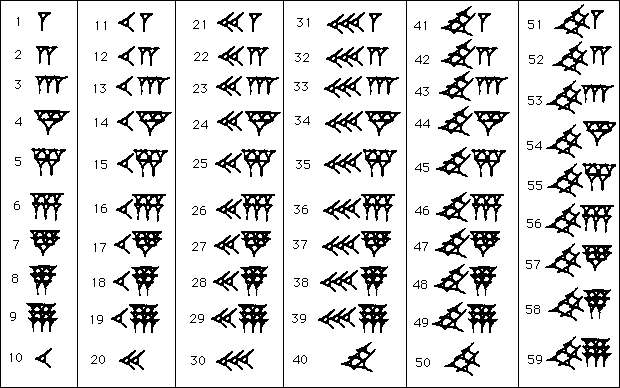
Thanks to the MacTutor History of Mathematics Archive for the picture!
Take that, Larry Summers! December 15, 2011
Posted by mareserinitatis in education, feminism, math, papers, science.Tags: intelligence, male variability, math
add a comment

I came across an article on the new research by Kane and Mertz which supposedly disproves the “greater male variability” hypothesis. That is, while averages for both genders are approximately the same, males have more variance in their intelligence. Thus, when intelligence tested, you’ll see more males at both the upper and lower tails of the distribution.
When Larry Summers was talking about the greater male variability hypothesis (GMVH) in his really awful speech, he was talking about those who are at least two standard deviations away from the mean. If you look at the distribution of IQ for each sex, which is what he was referring to, you can see that the ratio at the 98th percentile is approximately 2:1 male to female.
If IQ were an accurate predictor of success in academia and academics came primarily from that top 2% (neither of which are universally true), you would then expect to see approximately 2 men for every woman in those professions. Unfortunately, the ratio is much worse than that (from the perspective of women and feminist men, anyway). This very compelling evidence of social, cultural, and/or economic factors, potentially up to outright sexism coming into play when women are being considered for academic positions. The fact that it is still so far from this ratio makes me have a lot of issues with Larry Summer’s argument. Aside from all that, there is the issue that IQ isn’t the best predictor of success.
However, let’s pretend it is…or that it at least that it may be reflected in math achievement for the tests used in the study. In the study, they took variances from scores on tests like TIMSS and PISA, both of which are given internationally and used to compare various countries’ standing. Specifically, the paper examined the variance question.
To do this, we can begin by looking at the data from IQ Comparison site, which says that the standard deviation in the WISC IV IQ test was about 14.54 for men and 13.55 for women. The variance is the square of the standard deviation, giving the variance for men as 211.4116 and women as 183.6025. If you want to do a comparison, just take the ratio of men’s variance to women’s and you’ll get a variance ratio (VR) of 1.15. Keep in mind that the data this is taken from the US standardization which was used to norm the test, and it was done in the early 80s. If you want to compare that to the data presented in the paper, the US VR in 2003 was 1.11 on the TIMSS and 1.19 on the PISA. In 2007, it had dropped to 1.08 on the TIMSS (no PISA data is given). Therefore, the VR has changed.
The authors use the math testing data to do this for many countries, not just the US. You would expect that if the GMVH is true, then you would see VRs of about 1.15 from most countries and that it is constant in time. What Kane and Mertz find is that the number seem to vary a lot, but many of them have changed. That by itself gives an indication that a VR of 1.15 is not fixed and that the VR may be somewhat cultural. Further, they changed through time. Some of the VRs increased, like in Australia, and some decreased, like Japan’s.
This is the table presented in the paper:

They then attempt to find a correlation between male variance and the VR ratio. If GMVH is true, you would also expect that a higher VR ratio would be highly correlated with males having a larger variance. That’s not what they find, however. The correlation value is fairly low, and the authors state that sometimes a higher VR is actually due to poorer performance on the test by boys.
There is significantly more analysis than I’ve communicated in this post, but the gist is that they found that gender equity in economic and educational arenas were the best predictor of test performance. This gives a good indication that the GMVH is bunk – performance in math is not biologically destined.
Jonathan M. Kane and Janet E. Mertz (2011). Debunking Myths about Gender and Mathematics Performance Notices of the American Mathematical Society


 I also blog at Engineer Blogs, home away from home to some of the best engineering blogs.
I might be *gasp* a role model March 15, 2012
Posted by mareserinitatis in education, feminism, gifted, math, societal commentary, younger son.Tags: feminism, girls, math, nerd girls, role models
4 comments
My younger son is in chess club, and one of the girls, whom I’ll call K, is in his class and also in the club. K is a pretty bright cookie as she has won things like spelling bee and chess tournaments. I was picking him up from the club on Tuesday when K said hi as she walked by. A couple seconds later, K came back to ask me if I would be coming to their class for our weekly math lesson this week. I said I would, and she cheerily went on her way.
I went in for our lesson earlier today, only to find that the teacher was sick. Rather than work with the smaller group of kids as planned, I offered to read the whole class a math story (which I’ve been doing every other week). So I read Sir Cumference and the Isle of Immeter. They were all very excited, and there was a lot of discussion about the story.
At the end of the session, one of the girls came up to me (whom I’ll call F). F isn’t in the group I work with regularly, so I don’t know much about her other than she’s not as advanced in math. (I assumed that meant she wasn’t all that interested in it.) She’d been in the restroom and had missed the first page of the story and wanted to see it. I said I could leave the book with her to read. She was very excited. Then K came up and gave me a hug, and after she was finished, F gave me a hug. I was rather shocked, though certainly not unhappy about it.
I’m trying to process it, though, and it seems interesting in light of a couple semi-related things. First, I came across an article about how reducing academic pressure helps kids succeed. Given the younger boy was having huge difficulties with perfectionism, my response to this was, I admit, nothing more than, “Duh!” We’re helping him to deal with this by using his math program. Some days he does very well, other days, he’ll get somewhere between 75% and 80% right. I try to tell him that I appreciate his hard work, and that if he doesn’t get it right, it only means he needs more practice. He’s also learning that he almost never gets 100%…and that is making him okay with doing things wrong. Yeah, he still gets frustrated, but he’s not so scared to try anymore.
However, I realized that I’m kind of doing this with the kids I’ve been working with at school. I’m doing stuff with them that I don’t completely expect them to get, but I also don’t get upset if they get it wrong. And there’s no grades. We’re doing it to have fun and to learn, and I think the kids really like doing something just for fun.
Another recent event was when a coworker started lamenting to me how his daughters, who are middle school aged, seem uninterested in math. Being an engineer, he’s very disappointed, especially because they seem to be quite good at it. I suggested he get the books written by Danica McKellar and give them to his daughters.
Now, I have to say that I can’t imagine myself reading those books when I was that age (of course, I could very well be wrong – although I had some unusual role models). On the other hand, I figure that if there are bright girls out there who are eschewing math and these books get them interested, then I’m all for it. It turns out that my coworker did give them the books and, even better, they really seem to be enjoying them. Maybe they won’t turn into math majors, but he seems a lot happier, and they may be enjoying math more.
I’ve talked about efforts like Nerd Girls in the past, and I have to admit I felt it was stupid to try to ‘girlify’ engineering to attract women. On the other hand, I’m obviously the kind of woman who wasn’t very stuck on social messages about women in science or engineering. It’s not hard to imagine that there are a lot of young, intelligent girls out there who feel social pressure to avoid technical areas because they lack role models. Maybe some of those girls really need things like Nerd Girls and Danica’s books. I don’t have any daughters, so I can’t really say much based on experience. After my experience today, though, I’m wondering if female role models are far more important to some girls than I ever thought.