Never ask a woman her weight…but her kinetic energy is fine August 2, 2014
Posted by mareserinitatis in math, physics, running, science.Tags: blerch, gravitation, kinetic energy, mass, physics, runners, running, science, velocity
add a comment
Today, I had one of the most awesome runs I’ve ever had. In particular, I sustained a much faster pace than I have over a 3 mile distance.
I couldn’t help but wonder, however, about the factor weight plays in one’s speed. As much as I try not to worry about weight and focus on being healthy, there’s this part of me that thinks it would be cool to lose a bit of weight because then I would go SO MUCH FASTER. Or at least that’s what I tell myself. However, I wondered if maybe I was exaggerating a bit, so I decided to check it out.
While it’s a bit of an oversimplification (that doesn’t take into account muscle tone, lung capacity, hydration, electrolyte levels, altitude adjustment, and the 18 bazillion other things that can affect a runner, even as stupid as that kink that’s still in your neck from last Thursday’s swim (okay, that only affects the triathletes here)), a quick check is to use the kinetic energy equation.
First, of course, we have to assume a perfectly spherical runner. Or a Blerch:

The Blerch
(As an aside, if you don’t know what the Blerch is, you must check out the Oatmeal’s wonderful cartoon on running. We all have a Blerch deep inside of us.) Either way, perfectly spherical things are happy for physicists because of all the lovely simplifications we can use in learning about them. So, if you’re a perfectly spherical runner, remember that physicists will love you.
Anyway, our hypothetical runner will have a mass (m), which is, of course, directly proportional to weight. (Weight, of course, is also referred to as gravitational attraction, so the more you have of it, the more attractive you are, at least from the perspective of the planetary body you’re closest to. Also, it may start to be more attracted to you if your velocity starts to approach the speed of light. Maybe this is why many humans also find runners attractive? Not sure.) The unit of mass is the kilogram. The runner will also have to maintain an average speed velocity (v), and of course your pace is inversely proportional to your velocity. Your velocity is probably measured in miles per hour by your local race, but since we’re being scientific, we could also use SI units of meters/second. That being said, if you double your speed in one unit, it will also double in the other. There’s nothing fancy that happens because you’re using one unit or the other.
The kinetic energy of our runner, assuming an average velocity, can be written as
(1) KE=½ mv2
If we have the kinetic energy and mass, but want to find out the velocity, we first divide both sides of the equation by the mass and then take the square root of both sides. This leaves us with the following result:
(2) v=√(2 KE/m)
Let’s take an example. If we have a runner who has a velocity of 5 mph (or 2.2352 m/s) and a weight of 140 lbs. (or 63.5 kg). If we use SI units to compute this runner’s velocity, it turns out her initial kinetic energy (KEi) is 158.63 J.
On the other hand, we don’t really need to know how much initial kinetic energy the runner has, in terms of numbers. We can just define it as the quantity KEi. It turns out that physicists are kind of lazy about using numbers, so we’ll try to go without them because, in my opinion, it sort of confuses things. (You’ll see why later.)
How this this help us? Well, if you want to take a drastic example, let’s assume a runner loses half of her body weight.
First, let’s establish that her initial kinetic energy is defined also by an initial mass mi and velocity vi. (These would be the same as the 5 mph and 140 lbs. above.) This means her initial kinetic energy can be written as
(3) KEi=½ mivi2
and her initial velocity would therefore be
(4) vi=√(2 KEi/mi).
If her weight drops by half, we can write this as her initial weight divided by 2:
(5) m=mi/2
If we put (5) into our velocity equation (2) as our new mass and keep the same initial kinetic energy, we get
(6) vnew=√(2 KEi/m)=√(2 KEi/(mi/2))=√2*(2 KEi/(mi))=√2√(2 KEi/(mi))
You can see that the last part in six is basically the square root of two times our initial velocity from (3). That means that by losing half her weight, our runner would run about 1.4 times as fast, or 40% faster.
Now what if she only loses 10% of her weight? It turns out that (5) would become
(7) m=mi/1.1
so our new velocity would be the initial velocity times the square root of 1.1, which is about 1.05. Losing 10% of her weight only makes her 5% faster.
After spending time looking at this, I decided that going on a massive diet definitely isn’t going to help me speed up significantly. (In fact, if I manage to go from my current weight to my ideal, I would maybe get a gain of a bit over 1/2 mph.) It’s the fact that the mass doesn’t play as strong a role as velocity does because velocity gets squared and mass doesn’t. If you want to go faster, you are better off practicing running faster.
So please pass the ice cream! I need it for my fartlek recovery.
Math is a #firstworldproblem June 1, 2014
Posted by mareserinitatis in education, math, teaching.Tags: math, teaching
add a comment
I was recently having a conversation with a friend about teaching when she launched into a complaint about students not understanding logarithms. The conversation became somewhat off putting because this friend fell into the trap of equating mathematical knowledge with intelligence. A lot of people do it: English majors will imply one is an idiot if one doesn’t appreciate the succinct stoicism supplied by Hemingway, for example. (And I use this example because I’ve been on the receiving end of such criticism: I can’t stand Hemingway, and it was torture having to relive it when the older son was reading and explaining Old Man and the Sea for one of his classes.) Hemingway hating aside, many of us tend to use certain sets of knowledge as a reflection of intelligence, and that’s rather simplistic (and not all that intelligent of us).
The reason this particular discussion irritated me is because there is a level of classism that seems to go hand-in-hand with assumptions about mathematical literacy. While being mathematically literate is a good thing, the reality is that I’ve met very mathematically illiterate folks who were able to navigate through life with no problems. Not knowing logarithms didn’t hinder them professionally or personally. Not knowing logarithms was no indicator of their intelligence. Not knowing logarithms didn’t stop them from appreciating, or at least tolerating, Hemingway.
In my experience, math illiteracy often has a basis in background. Kids whose parents are highly educated and/or wealthy often have a greater chance of both being exposed to advanced math concepts as well as being able to use such concepts more proficiently. In my classes, I’ve noticed a huge problem: kids from larger, urban schools and who aren’t minorities seem to be more likely to stick with engineering than either minority students or those from rural backgrounds. Kids who have engineers in their family are more likely to stick with it, as well. While this isn’t a surprise, and there’s been a lot of explanation as to why this is so, I suspect exposure to and comfort with math concepts is a big factor. Not only are they already feeling at a disadvantage because they are having to start farther behind their peers in the curriculum progression, they are often advised to change majors because their lack of math implies they aren’t cut out for the rigors of a technical profession. I’ve heard about this happening to my students as well as it happening to me. (I was once told that I should never have been accepted to college because I didn’t know Euler’s formula giving the trigonometric form for imaginary numbers.)
Living through those types of experiences has made me go out of my way to ensure that my kids have an excellent background in math before entering college. At the same time, because I’ve made a point to provide that level of education, I’ve become aware of many kids who don’t have those opportunities. There are a lot of bright kids who are forced to stick with grade level instruction despite the fact it’s obvious they’d benefit from acceleration. And then there are the kids for whom rigorous instruction and acceleration aren’t possible because it’s beyond their parents’ means and ability.
Back to my friend, it was hard to convince her that these kids weren’t stupid, and she seemed unwilling to accept that there wasn’t something wrong with the world that kids who don’t understand logarithms can actually go to college. I apparently couldn’t convince her that they’d be okay and maybe they just needed a bit more guidance to assimilate into the world of mathematical literacy. Perhaps we should’ve discussed literature instead.
A Rite (Triangle) of Passage May 13, 2014
Posted by mareserinitatis in education, family, gifted, homeschooling, math, older son, teaching, younger son.Tags: homeschooling, learning, learning styles, math, pythagorean theorem, visual-spatial, younger son
1 comment so far
 The younger son recently started his pre-algebra class. Somehow, this has made math a bit better. I think the fact that it has algebra in the title makes him feel very accomplished and that, in turn, has made him more enthusiastic about math.
The other day, he was doing some of his homework, and the lecture was confusing to him. I listened to the lecture and then said, “It makes more sense if you draw a picture.” He responded that, “Pictures always help me learn better. I guess the math program doesn’t realize that some of us are visual learners.” I was both amused and quite stunned. I think I’ve been discussing educational theory a bit too much at the dinner table. I can tell he’s listening to us.
Tonight, he hit a milestone. He called Mike over, and I followed, so he could ask us how to pronounce “pythagorean.” He was sure he’d heard us talking about it before (yeah, we discuss this stuff around the dinner table), and he wanted to be sure that was what it was.
“Oh, wow!” I said. “You’re doing the Pythagorean Theorem. That’s awesome!” Suddenly, there was an impromptu round of cheering and high-fiving. The older son even came over and gave his little brother a big hug, saying, “Woo hoo! The Pythagorean Theorem is awesome.”
As the lecture progressed, it reiterated the terminology, focusing on right triangle legs and hypotenuse. Given I’ve had ZZ Top in my head, I had to immediately sing, “She’s got legs! She has a hypotenuse!” I wasn’t able to come up with much more, though.
Yes, I have to admit that I realized how odd it was, in retrospect. We were having a celebration that younger son had made it to the Pythagorean Theorem, and we were all making a huge deal about it.
But younger son didn’t think so. He thought it was awesome and giggled continuously for the next few minutes. I guess he likes having a math cheer team.
The “dear teacher” letter November 11, 2013
Posted by mareserinitatis in education, gifted, math, teaching, younger son.Tags: gifted, gifted education, math, teaching, younger son
1 comment so far
Last week was parent-teacher conferences at the younger son’s school.
If you don’t know, I dread these things. I had been feeling better after last year, but then I realized I’d been lulled into a false sense of security. In particular, two years ago, younger son’s teacher was having a fit because he wasn’t doing math with all the other kids. The thing we kept getting was, “He’s really not all that great at math.” Last year, we attempted to have the younger son do his math curriculum at school. We kept trying for a month. However, it was very clear that his teacher was unable to help him, so they sent him out into the main office area where there was a lot of traffic…and no one to help him. We said we would take care of it at home and didn’t hear another thing about it again.
At the beginning of this year, there was some noise that he would do the math at home in addition to the math at school. We quickly put a stop to that and said, “You’re punishing him for being smart.” Making him do two sets of math a day is no good.
The thing is, I really don’t understand this. He’s doing excellent by standardized testing standards. What more do they want? I sure hope they aren’t saying, “If Johnny worked just a bit harder, he would be at the 98th percentile instead of the 96th!” Or are they saying that if they worked harder, they could beat Suzie’s score in math? I seriously doubt it…and if they are, then I think they’re a little bit whacked. All I can think is that this is either a control issue or a conformity issue. It has absolutely nothing to do with his math ability.
Which, incidentally, isn’t all that good. “You know, he’s not the top student in the class as far as math testing goes.” That’s what we got. I suspect this is, “He’d be doing better if he was doing math with all the rest of his classmates,” as in I should feel guilty for making him miss out on the stuff his friends are doing.
Unfortunately for her, I really get irritated with things like guilt trips and appeals to social norms. I really don’t care if my kid is doing something different.
The other issue is that it has *everything* to do with his math ability. She’s taking math scores and comparing them to other kids. We already know that his processing speed may not be that great and that he’s not the kind of kid who likes to spend time memorizing things. Math at the elementary level is all about those things: computation and recall. However, his reasoning and visualization skills are really great. Like most elementary teachers, I think she doesn’t understand that math is more than multiplication tables. She recognized that he knows those things, but that maybe he needs time to figure it out rather than having it at the tip of his tongue. What she doesn’t realize is that he’s not the kind of kid who is going to tolerate endless drilling of memorization facts when his real strengths are in logic and reasoning. Would you like math if it was always doing the types of things you hate? This kid is stoked to get into algebra soon…why would I want to kill that and tell him he needs to practice flash cards more?
There are ‘optional’ tests on the MAPs in science and science reasoning. His scores in both those areas were the same for 10th graders and above, according to national norms. Why do they always want to hold kids back to their weakest skills, even when those skills are still obviously above average for their age mates? Even in his ‘weak’ area, he’s still near the top of his class…and they conveniently ignore his strengths and pretend like those have nothing to do with the issue at hand.
I have to write this teacher a letter with some follow-up information. However, there is a part of me that wants to ask why there is such a focus on holding younger son back when they should instead be focusing on allowing ALL of the children to perform at a level appropriate to their abilities.
You see, when she said he wasn’t at the top of the class in math, I didn’t feel guilty. I felt bad for those other kids because they were being held back and not having the opportunity to work on interesting and challenging work the way younger son is. Rather than being ashamed that my son is getting to do things he finds interesting and challenging (so that he’s also learning about having to work hard and deal with frustration), I wondered why the teacher and school aren’t ashamed of what they’re doing to those other students.
It’s official: younger son is smarter than I am. October 3, 2013
Posted by mareserinitatis in gifted, homeschooling, math, younger son.Tags: EPGY, math, younger son
add a comment
Younger son isn’t one you’d pinpoint as being very gifted…at least I wouldn’t. I have had random people tell me that he’s quite bright, but that’s never what has come across to me. He’s very outgoing and socially conscious…VERY big on morals and ethics. Fun. Goofy. Just wants to get his homework done so he can play.
In other words, to me he seems like a perfectly normal little boy.
In math, he’s one of these kids who struggles with computation. Not as badly as some kids (*ahem* older brother *ahem*), but it is his computation that slows him down. He’s enrolled in Stanford’s EPGY program for math, which we do at home (even though the school still grumbles occasionally). I thought he’d get into the program, but I was honestly stunned at his ability to answer logic questions. I remember when he took the test, I was watching, trying to puzzle through some of the questions and he was already onto the next question. It made me realize that there’s obviously some ability there…but because of the computation issues, he struggles to express it.
When helping the younger son do some homework on percentages earlier this week, he made a very interesting comment:
When you divide an even number by an odd number, except five, you get a repeating decimal. When you divide an odd number by an even number, though, you just get a remainder.
Is that right? It sounded like it was plausible, but I’d never come across such a rule. I had to look it up.
According to Wolfram’s MathWorld, if the divisor is a multiple of two or five you get finite decimal expansion. If, however, the denominator contains a prime other than 2 or 5, you’ll get a periodic decimal expansion (i.e. repeating decimal).
So he was very close and might have been able to prove it by induction for very small n…if he knew how to do proof by induction.
It kind of stunned me, though, that he was trying to figure this out and neither Mike nor I had ever given it any thought.
Math illiteracy at the bank September 29, 2013
Posted by mareserinitatis in family, math.Tags: math, Mike, money
2 comments
The older son received a check, and we went to the bank to cash it. He was supposed to put half in savings and keep the rest for spending money. The check was for $53.50.
When we got to the window, Mike told the teller that half should go into savings and the rest should come back as cash. We were in our car, so said that $26.75 needed to go into savings, but he didn’t pass that info to the teller. After a minute, she asked if we wanted the $.50 back as cash. I could only roll my eyes because I knew what had happened.
The teller had deposited $26 into savings and returned $27.50 as cash. Apparently it was a bit too intimidating to take that $1.50 difference and divide it in half. We just took it and left because it wasn’t worth getting upset about it. However, I told Mike that he needs to stop overestimating people’s math skills…even if the person is a bank teller.
Wordless Wednesday: To find your P-value September 17, 2013
Posted by mareserinitatis in computers, math, photography.Tags: jokes, pictures, software, wordless wednesday
5 comments
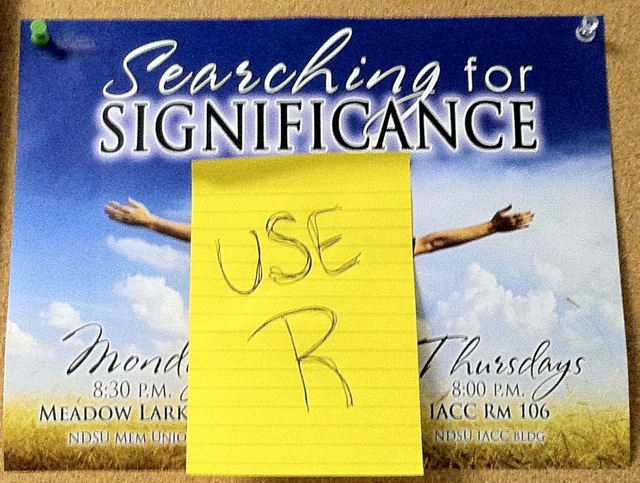
Does this make me multilingual? July 16, 2013
Posted by mareserinitatis in computers, electromagnetics, engineering, grad school, math, physics, research.Tags: computers, dissertation, fortran, languages, programming
3 comments
I began my programming education quite young and have maintained my skills over the years. I have recently been thinking of documenting some of the various languages and software programs I’ve learned to use, so here is as good a place as any.
- 4th grade – TI Basic
- 8th grade – Logo
- 10th grade – BasicA and Apple Basic (pretty close to the same thing)
- 12th grade – Fortran and QBasic (these were at the college)
In college:
- took a class on C and had to learn unix, too
- learned Maple in a calc course
- learned matlab for a research project and used it extensively in a numerical analysis course
- learned mathcad for a physics lab course
- learned mathematica for intro to differential equations and used that for many other classes
During my MS, I was exposed to half a dozen software packages for computational electromagnetics modeling (half of which are trademarked, so I’m not going to bother listing them).
In the past couple years at work, I’ve gotten pretty handy with Scilab.
After all of this, you would think that I have a pretty complete toolkit. I should be able to do pretty much whatever I need with what I’ve already learned. I find it ironic, therefore, that I am back to using Fortran (one of the first things I learned). I also have been spending the past month trying to learn IDL (which, if you don’t mind me saying, seems like a less friendly version of matlab), so there is something new, again. Also, I have people pestering me to learn python.
Looking at this list, I’m starting to think I’m learning things so that I can simply forget them again later. I’m pretty sure I’ve forgotten more than I remember.
Wordless Wednesday: equations in the window July 10, 2013
Posted by mareserinitatis in family, math, photography.Tags: equations, math, Mike, pictures, refraction
add a comment


 I also blog at Engineer Blogs, home away from home to some of the best engineering blogs.
A filtered education March 3, 2014
Posted by mareserinitatis in education, homeschooling, math, older son, physics, science, societal commentary, teaching, younger son.Tags: light, older son, physics, science, science education, teaching, younger son
add a comment
The older son is a lot of fun. Despite his statements that he has no desire to go into science, he seems to get and make a lot of science jokes. I know he’s not a scientist, but I feel comfortable that he’s scientifically literate. As he was homeschooled, I’m feeling pretty proud of myself.
I’m more anxious about the younger son, though. This weekend, he brought home his science homework, which focused on optics. The kids were studying filters, and one of the questions asked about what kind of light would you see if you shined a flashlight through a blue filter and then a red one. I asked him what he saw, and he said nothing. Unfortunately, he was told that he saw nothing because the flashlights just weren’t bright enough, but that what he should have seen was purple.
I’m pretty sure that if I had ever been bombarded with gamma rays in the past, I would’ve turned into She-Hulk at that very moment and started smashing things. Fortunately (or unfortunately, if being She-Hulk happens to be a goal of yours), that didn’t happen.
I find it infuriating that, throughout my years of homeschooling older son and teaching younger son math, I have constantly been questioned about my ability to teach them. The implication has always been that I may have a degree, but they are experts on teaching. In fact, this particular teacher attempted to take me to task earlier this year about the younger son’s math curriculum…the same teacher who apparently doesn’t understand that light and pigments work completely differently.
After I managed to calm down, I explained that light filters are like sieves, except that they only let one size of particle pass through: nothing bigger can pass through the holes, but nothing smaller can, either. After this explanation, the younger son was able to correctly explain that the reason he saw no light from his flashlight is that the two filters together had blocked all the light.
I’m going to be watching very carefully to see what kinds of scores he’s getting on his answers and whether the teacher realizes she made a mistake. This was very disappointing. There was a new science curriculum introduced this year, one which I was very excited about. The focus was supposed to be on hands-on, problem-based learning, which is great for science. Despite that, it seems that younger son’s science education may be lacking. What good does it do to have a top of the line science education curriculum (or math…or anything else) when our teachers don’t understand what they’re teaching? And how is it that these same teachers can justify questioning the ability to teach material that some of us understand far better than they do?