Second grade logic and rulers February 23, 2012
Posted by mareserinitatis in education, gifted, math, teaching.Tags: angles, education, geometry, kids, rulers, sir cumference
add a comment
Today, I went back to work with the second graders. We’ve been spending a lot of time talking about circles and degrees and Babylonian units and π.
My plan has changed from the original one of trying to teach the kids a bunch of applied stuff. I’ve pretty much given in to teaching them historical discoveries in math simply because there’s a lot of stuff you can do that doesn’t require multiplication and division. It’s been a lot of fun, but I decided to try something different but related: I wanted to teach them out to make a formal mathematical proof. Okay, not terribly formal. What I want them to learn is how to use logic to make a proof. I suspect some of them know already (based on some of the arguments I’ve had with my son who has rock solid 7-year-old logic). However, I’d like them to use their brains for good instead of getting out of (or into) trouble.
The thing about geometrical proofs is that they really aren’t that hard. At least, I never found them to be. I remember sitting in 10th grade geometry and being given T-charts. I would race through them and ace them all. I was horribly surprised to see that my classmates had difficulty with them as well as complaining the teacher was too abstract. I threw the idea of proofs out to Mike, and he said that pretty much the only tool you need is a brain, so it’s probably a good idea. (I’d have to disagree…you need a brain…but you also need a pencil, paper, ruler, and protractor. But otherwise, I think he’s right.)
Today, we started with the concept a line and measuring its angle. I know my former math instructor wouldn’t approve, but I’m teaching them to use degrees (aka Babylonian Units) because that’s what’s on the protractor. Also, I’m not sure how versed they are in fractions, so we’re not going to get into fractional parts of π. (Actually, if anyone has ever seen a protractor with units of π rather than degrees, please let me know as I’d love to buy it.)
Once we had a line, then I told them to draw a point on the line with another line coming out of it, so that it would look like this (without the measurements):

Each of them drew the line coming out an a different angle. They all measured their angles and found that they all summed to 180°. A couple of the kids seemed surprised that they all ended up with the same number. Incidentally, those that didn’t seem surprised were very absorbed with the flexible rulers I had brought to use. (Note to self: second-graders are easily distracted by anything novel.) We then talked about how any two angles, if they formed a straight line, would add up to 180° and how this was known as the supplementary angle theorem.
Once we had that down, we used it to prove the vertical angle theorem. It took them a bit to realize that the line created by adding supplementary angles doesn’t have to be horizontal (like in the picture above).
That’s all we got through today, but I plan on using this to show them that the interior angles of a triangle always add up to 180°. It might take us a couple weeks to get there, especially since next week I’m supposed to read them a couple more of the Sir Cumference books.
My many hats February 9, 2012
Posted by mareserinitatis in computers, engineering, gifted, homeschooling, math, teaching, work, younger son.Tags: division, minion, software, work, younger son
7 comments
A couple weeks ago, my blog was promoted by a couple of sites and the hits started flowing in. I commented to someone (most likely Gears) how it’s nice to be recognized for my blogging about engineering but frustrating for the lack of recognition for my actual engineering work. Guess I should’ve waited a couple weeks.
Normal work has also been crazy. I’ve been given full control of the Minion and have thrown him in on a new project where he’s learning everything from scratch. It’s similar to projects that I’ve done, but even more complicated and using a different program. So our next couple weeks are going to be real fun as we’re going to be trying to make our way through using this new program and occasionally resorting to the old program for reality checks.
The other serious challenge I’ve been dealing with this week is long division. It’s pretty scary stuff, especially when you have a seven-year-old who is fighting some rather strong perfectionistic tendencies. He’s been getting to the long division portions in his computer math, and he starts to shut down. I’ve been getting more and more frustrated with it, so I decided to put an end to it tonight. I went back and printed out some of the older homeworks so that we could take a couple steps back. I think the problem is that he really thinks he can do everything in his head. I have to admit that his ability to do mental math far outweighs mine: I simply have to write everything down. However, he’s starting to hit the limit of this particular ability, and so he freaks out whenever he has to do a problem where he can’t do it all in his head.
I told him that tonight’s homework was going to be doing some work sheets. With the problems written out on paper, he didn’t seem to have this idea that he had to do everything in his head. The first couple were challenges, but then he started getting the hang of things and was able to execute the last few problems very quickly. By the time we had finished, he was doing 3-digit numbers divided by 2-digit numbers with no problem. We’re going to do some more difficult problems tomorrow and then try heading back to the computer.
We tried a similar approach when he started to get stuck on multiplication a couple months ago. I guess there are some things that really have to be written out to be understood. I just hope he starts to make regular use of his notebook from here on out.
How I can tell the younger son is my child… January 28, 2012
Posted by mareserinitatis in math, younger son.Tags: math, minus, negative numbers, younger son
4 comments
The younger son is learning how to manipulate negative numbers in math. However, he was getting very irritated when listening to the ‘lectures’ yesterday. The lecture would use the term ‘minus’, as in -6 is pronounced ‘minus six’. Every time it did that, the younger boy would make some exasperated grunt and say, loudly, “Negative!”
I can only think this may be because I always call them ‘negative’. The term minus, to me, implies an operation. If so, he obviously picks up on subtleties a lot better than I thought.
Outnumbered January 5, 2012
Posted by mareserinitatis in gifted, math, teaching, younger son.Tags: math, teaching, younger son
1 comment so far
Today I’m going to be working with the elementary students again. This will be interesting as I completely switched gears from what we were doing before. The stuff we were doing before was fun, but as we move through the book, it looks like they need a lot of multiplication and division…which most second graders don’t have.
Today, we’re going to learn about other number systems. In particular, I’m going to have them pick a number using Indo-Arabic numerals and ‘translate’ into other numbering systems – Egyptian, Roman, Babylonian, Mayan, and Chinese. This will give us an opportunity to talk about different bases, positional numbers (i.e. the concept of place value), and how many systems don’t have a zero. (Although, there’s debate in some cases.)
After doing the prep, I’m SO glad that we don’t use the Babylonian system. Base 60?! No wonder my math professor got annoyed when we used degrees.
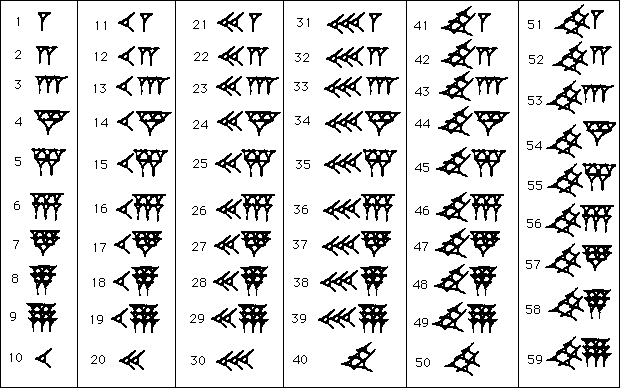
Thanks to the MacTutor History of Mathematics Archive for the picture!
Wordless Wednesday December 21, 2011
Posted by mareserinitatis in family, food/cooking, math, older son, personal, pets, photography, religion, younger son.Tags: cooking, food, Gigadog, hannukah, older son, younger son
add a comment



Take that, Larry Summers! December 15, 2011
Posted by mareserinitatis in education, feminism, math, papers, science.Tags: intelligence, male variability, math
add a comment

I came across an article on the new research by Kane and Mertz which supposedly disproves the “greater male variability” hypothesis. That is, while averages for both genders are approximately the same, males have more variance in their intelligence. Thus, when intelligence tested, you’ll see more males at both the upper and lower tails of the distribution.
When Larry Summers was talking about the greater male variability hypothesis (GMVH) in his really awful speech, he was talking about those who are at least two standard deviations away from the mean. If you look at the distribution of IQ for each sex, which is what he was referring to, you can see that the ratio at the 98th percentile is approximately 2:1 male to female.
If IQ were an accurate predictor of success in academia and academics came primarily from that top 2% (neither of which are universally true), you would then expect to see approximately 2 men for every woman in those professions. Unfortunately, the ratio is much worse than that (from the perspective of women and feminist men, anyway). This very compelling evidence of social, cultural, and/or economic factors, potentially up to outright sexism coming into play when women are being considered for academic positions. The fact that it is still so far from this ratio makes me have a lot of issues with Larry Summer’s argument. Aside from all that, there is the issue that IQ isn’t the best predictor of success.
However, let’s pretend it is…or that it at least that it may be reflected in math achievement for the tests used in the study. In the study, they took variances from scores on tests like TIMSS and PISA, both of which are given internationally and used to compare various countries’ standing. Specifically, the paper examined the variance question.
To do this, we can begin by looking at the data from IQ Comparison site, which says that the standard deviation in the WISC IV IQ test was about 14.54 for men and 13.55 for women. The variance is the square of the standard deviation, giving the variance for men as 211.4116 and women as 183.6025. If you want to do a comparison, just take the ratio of men’s variance to women’s and you’ll get a variance ratio (VR) of 1.15. Keep in mind that the data this is taken from the US standardization which was used to norm the test, and it was done in the early 80s. If you want to compare that to the data presented in the paper, the US VR in 2003 was 1.11 on the TIMSS and 1.19 on the PISA. In 2007, it had dropped to 1.08 on the TIMSS (no PISA data is given). Therefore, the VR has changed.
The authors use the math testing data to do this for many countries, not just the US. You would expect that if the GMVH is true, then you would see VRs of about 1.15 from most countries and that it is constant in time. What Kane and Mertz find is that the number seem to vary a lot, but many of them have changed. That by itself gives an indication that a VR of 1.15 is not fixed and that the VR may be somewhat cultural. Further, they changed through time. Some of the VRs increased, like in Australia, and some decreased, like Japan’s.
This is the table presented in the paper:

They then attempt to find a correlation between male variance and the VR ratio. If GMVH is true, you would also expect that a higher VR ratio would be highly correlated with males having a larger variance. That’s not what they find, however. The correlation value is fairly low, and the authors state that sometimes a higher VR is actually due to poorer performance on the test by boys.
There is significantly more analysis than I’ve communicated in this post, but the gist is that they found that gender equity in economic and educational arenas were the best predictor of test performance. This gives a good indication that the GMVH is bunk – performance in math is not biologically destined.
Jonathan M. Kane and Janet E. Mertz (2011). Debunking Myths about Gender and Mathematics Performance Notices of the American Mathematical Society
The magical standardized exams December 9, 2011
Posted by mareserinitatis in education, gifted, homeschooling, math, older son, science, societal commentary, teaching.Tags: education, SAT, standardized exams, testing
2 comments
I’ve been reading a lot of different takes on the whole fiasco of the Florida school board member with two MS degrees who failed the state’s 10th grade standardized test. His name is Rick Roach.
While it doesn’t seem to be a popular view, I am agreeing with Roach: the test really doesn’t have anything to do with how people will fare in the real world. I’d dare say that grades are probably a better predictor, although they have their flaws, too. Students who do well in school tend to be those who read teachers well and know what they want. They don’t have to be very bright to figure out how to keep teachers happy, follow the rules, and, in general, conform. They stay organized, hand in their work, which was hopefully done well, and keep the people around them happy. I hate to say it, but these are the skills that tend to help people at a job, not passing a standardized exam.
In my view, people who do well in life are those who are able to conform to the expectations of those around them OR those who follow their passions and work very hard at them. I don’t believe that tests do much more than how well one takes tests. And, to be perfectly honest, I’m not sure all the emphasis on getting kids up to speed in science, math, and reading is doing much good and may, in fact, be doing a significant amount of harm.
The reason I say this is the experience with my older son, who is now a sophomore in high school. So let’s start out with a shocker: he got kicked out of school recently. He was going part-time, but he wasn’t sufficiently interested and never made it a priority to be there. This is the same kid who became so engrossed in studying US history that he passed both CLEP exams on the subject, earning him a full year of US history credits at most colleges…in 9th grade.
We decided we better start looking at how he’s going to get his degree, so I figured that since he’s almost 16, he can start prepping to take the GED. For those of you who are unfamiliar, this is a high school equivalency exam, but you can’t take it until you turn 16. It tests on reading, writing, science, social studies, and math. While he has had a decent amount of algebra, he’s never had a formal science class except for one in 6th grade. However, he passed the practice GED with no problems, meaning that he probably won’t even need to study before he can take the exam in a couple months. He’s very happy about that because he doesn’t want to spend his time studying for that: he wants to study to take the macroeconomics CLEP instead. The kid who doesn’t want to be bothered to make it to school on time will work his but off to study something he’s interested in.
I have a kid who is good at passing exams. I don’t have a kid who is a conformist and understands the need to be places on time. (Well, I think he understands…but he’s not going to make the effort unless he really cares about it.) Unfortunately, I think his lack of conformity is going to hurt him a lot in life, probably more than his exam-taking ability will help him. He’ll have an easy time earning his high school equivalency, but what good will this do him if he’s not going to be able to keep a job if he decides he’s not sufficiently interested in working?
I have also come to the realization that he really doesn’t need to know much math. In fact, I think most people don’t. Being a scientist, I use math day in and day out. In my work as an engineer, I don’t use nearly as much math as you’d think. In fact, like Roach said, I know a lot of people who don’t use math all that often. A lot of those people are engineers. A good chunk of engineering education involves teaching processes that invalidate the need for much higher level math. Yes, a lot of it is a cookbook for boiling things down to high school algebra. Now, the good engineers will have a conceptual understanding of what’s underlying those steps, and the really good engineers will understand it mathematically. But realistically, most of what they learn in college, in terms of math, won’t be used. And I say this as someone who is frustrated because I’ve had a lot of math and realize I’m forgetting much of it because I don’t use it.
Going back to the discussion on this emphasis toward pushing more math, science, and engineering hurting students, I’d have to say that there are a lot more kids like my son than people acknowledge. Kids are going to be successful in life when they follow their passion. I’ve seen kids who showed no motivation in classes go and learn the information taught in those classes because they wanted to work on something that required that information. There is so much emphasis on establishing superiority in these academic areas (when we can’t even manage competency in most cases) that we’re not allowing kids a variety of experiences they need to find their interests.
Our education system provides no real motive for learning aside vague promises of getting a good job after high school. I’m sure most students think that their job will be a lot like high school, which is probably not all that inspiring. There is no real motivation for them to learn, their curiosity is damped, they’re never allowed to excel unless it’s in an area where our system is currently focusing. And even then, bright kids are bored because they’re not really allowed to excel and dig into things on a deep level: they have to stay lock-step with kids who have no interest.
The whole ruse reminds me of Fahrenheit 451, where the whole society is distracted by notions of this or that trivial thing being important. Our society is fixated on test scores and ‘competency’ in science and math and writing. However, we’ve failed to pay attention to how and why kids really learn, and we’re delusional to think that competence in testing is the only indicator of who will succeed in life.
Of course, colleges will have you believe this, and there’s a huge industry surrounding making you believe that and providing you with more and more tests you’ll need to pass (for a sizable fee) despite the fact that grades are still the best predictor of college performance. There’s also the politicians who are also convinced that this is the way to fix our country’s problems…most of whom benefit from the system as it is because their kids almost always end up as winners in the education race. It also makes them look like they’re doing something substantial for education, which is why we have the No Child Left Behind legacy.
The gist of this is that most tests are assumed to be measuring things they aren’t measuring. The SAT is not going to tell you if you are going to be successful in life. It can’t even tell you that you are going to do well in college. We are imbuing these tests with magical powers: they have become our Sorting Hat. We believe in the magic of these exams to put people in some sort of ‘succeed at life’ or ‘fail at life’ category because it’s easier than looking at the realities of how our educational system is truly dysfunctional.
The best students December 7, 2011
Posted by mareserinitatis in education, geology, math, teaching, younger son.Tags: animals, cub scouts, geology, math, younger son
add a comment
At teacher conferences a few weeks ago, my son’s teacher mentioned that she was going to be taking a short period during the day to break kids into two groups. One group needed some help with some of the more basic concepts in math, while the others seemed fairly advanced.
I got very excited, and I asked if I could come in and do some fun math stuff with the advanced group. She said she’d appreciate it because then she could focus on the other kids who needed more help with things.
Yesterday was my first shot at this. It’s only about 20 minutes of seat time once a week (along with about an hour of prep, considering I have to bring in materials). I worked with a group of six, and it was fun.
That’s the one thing about teaching college versus elementary school kids: college kids never get excited the same way little kids do. Of course, maybe it’s because you have to use a fundamentally different approach – more hands on – with little kids. On the other hand, I think you lose something with maturity. I have worked with a couple different cub scout groups, and they often have requirements to learn some geology for various badges. There is something amazing that happens when you put a group of 6-10 year old boys in front of rocks and other things they can touch. They’re fascinated with everything and seem to hang on your every word (when they’re paying attention). When you do the same to college kids, they just kind of shrug and proceed forth, maybe discussing the rocks with neighbors.
For these kids, I’m using a Mathworks book on how to be a zoo vet, and I decided to let each kid have their own animal as we work through the problems. Yesterday, we talked about building crates because we’re shipping our animals from one zoo to another. The kids were SO excited that they got their own animal. I tried to bring a variety: there were poison arrow frogs, king cobras, and piranhas for the boys and pandas and koalas and dolphins for the girls. I was pretty close: the two girls chose dolphins and koalas, and the boys mostly went for the dangerous animals. (One chose a polar bear, which is on the fringe between dangerous and cute and cuddly, IMO.)
Either way, they were really getting into building their crates. They were talking about the differences in sizes between all the animals, and it’s amazing all the movement and excitement and gestures that go into discussions among 7-8 year olds.
After the twenty minutes was up, I was exhausted. My comment about how college students never seem to get excited is exactly why I prefer to teach them: I can’t handle the energy level of really young kids all day long. I have to admit that I admire elementary school teachers for doing this. However, despite being exhausted, I was really tickled with their excitement and the fun we had. I’m looking forward to next week.
An appropriate challenge November 19, 2011
Posted by mareserinitatis in education, homeschooling, math, younger son.Tags: EPGY, math, perfectionism, younger son
add a comment
I’ve mentioned before that the younger son is doing math through Stanford’s EPGY program. In order to get into the program, he had to take an exam online to see if he qualified. Now that he’s enrolled, he gets weekly emails from his teacher talking about his progress. Most of the time, they say something like, “Keep up the good work.” I just tell the younger son that his math teacher is happy with his progress since he’s not real familiar with the concept of email. (Occasionally we’ll talk about some of the concepts she thinks need a bit more explanation.) I learned there’s a lot of other things he doesn’t quite understand…but I’ll get back to that in a moment.
Last month, he took a final exam to finish the grade he was working on. He didn’t pass, but he didn’t bomb it, either. He was a few points lower than the cutoff to go onto the next grade. It was a good thing, in retrospect.
The younger boy is a Perfectionist (with a capital P!), and it kills him to not do something perfectly. In fact, he refused to read until very recently because he couldn’t figure out all the words immediately. He was very disappointed when he didn’t pass the math exam and had to go back and redo some of the material. He retook the test a few days ago and got a very high grade. The lesson learned is that ‘failure’ isn’t death and doom…just means you need a bit more practice before you can go on. I think the practice did him some good as it seemed like he really got a better handle on things the second time around. I also think it helped him to see he isn’t expected to understand everything the first time he sees it. In other words, this is a good learning experience for the young perfectionist…one he would likely have not gotten in school given his grades are much higher there.
After finishing the test the second time, I showed him the email his teacher sent. I said that it was from his teacher at Stanford. I guess I’d never mentioned that bit before.
“My teacher is at Stanford?”
“Yeah, do you know what that is?”
“No.”
“It’s a big college that made the math program you’re using.”
“I didn’t pass the test the first time.”
“No, but that’s okay because it’s a hard math program. You just needed more practice. You wouldn’t be able to figure some of this stuff out unless you were pretty good at math.”
“Did you tell my teacher at Stanford that I’m good at math?”
“I’m pretty sure she knows.”
What’s kind of funny is that I don’t think he knows. That’s good, though, because it means he’s being challenged and not repeating work he already understands.


 I also blog at Engineer Blogs, home away from home to some of the best engineering blogs.
I might be *gasp* a role model March 15, 2012
Posted by mareserinitatis in education, feminism, gifted, math, societal commentary, younger son.Tags: feminism, girls, math, nerd girls, role models
4 comments
My younger son is in chess club, and one of the girls, whom I’ll call K, is in his class and also in the club. K is a pretty bright cookie as she has won things like spelling bee and chess tournaments. I was picking him up from the club on Tuesday when K said hi as she walked by. A couple seconds later, K came back to ask me if I would be coming to their class for our weekly math lesson this week. I said I would, and she cheerily went on her way.
I went in for our lesson earlier today, only to find that the teacher was sick. Rather than work with the smaller group of kids as planned, I offered to read the whole class a math story (which I’ve been doing every other week). So I read Sir Cumference and the Isle of Immeter. They were all very excited, and there was a lot of discussion about the story.
At the end of the session, one of the girls came up to me (whom I’ll call F). F isn’t in the group I work with regularly, so I don’t know much about her other than she’s not as advanced in math. (I assumed that meant she wasn’t all that interested in it.) She’d been in the restroom and had missed the first page of the story and wanted to see it. I said I could leave the book with her to read. She was very excited. Then K came up and gave me a hug, and after she was finished, F gave me a hug. I was rather shocked, though certainly not unhappy about it.
I’m trying to process it, though, and it seems interesting in light of a couple semi-related things. First, I came across an article about how reducing academic pressure helps kids succeed. Given the younger boy was having huge difficulties with perfectionism, my response to this was, I admit, nothing more than, “Duh!” We’re helping him to deal with this by using his math program. Some days he does very well, other days, he’ll get somewhere between 75% and 80% right. I try to tell him that I appreciate his hard work, and that if he doesn’t get it right, it only means he needs more practice. He’s also learning that he almost never gets 100%…and that is making him okay with doing things wrong. Yeah, he still gets frustrated, but he’s not so scared to try anymore.
However, I realized that I’m kind of doing this with the kids I’ve been working with at school. I’m doing stuff with them that I don’t completely expect them to get, but I also don’t get upset if they get it wrong. And there’s no grades. We’re doing it to have fun and to learn, and I think the kids really like doing something just for fun.
Another recent event was when a coworker started lamenting to me how his daughters, who are middle school aged, seem uninterested in math. Being an engineer, he’s very disappointed, especially because they seem to be quite good at it. I suggested he get the books written by Danica McKellar and give them to his daughters.
Now, I have to say that I can’t imagine myself reading those books when I was that age (of course, I could very well be wrong – although I had some unusual role models). On the other hand, I figure that if there are bright girls out there who are eschewing math and these books get them interested, then I’m all for it. It turns out that my coworker did give them the books and, even better, they really seem to be enjoying them. Maybe they won’t turn into math majors, but he seems a lot happier, and they may be enjoying math more.
I’ve talked about efforts like Nerd Girls in the past, and I have to admit I felt it was stupid to try to ‘girlify’ engineering to attract women. On the other hand, I’m obviously the kind of woman who wasn’t very stuck on social messages about women in science or engineering. It’s not hard to imagine that there are a lot of young, intelligent girls out there who feel social pressure to avoid technical areas because they lack role models. Maybe some of those girls really need things like Nerd Girls and Danica’s books. I don’t have any daughters, so I can’t really say much based on experience. After my experience today, though, I’m wondering if female role models are far more important to some girls than I ever thought.